Do you qualify for Sweden's digitalisation grant?
By Mohammed AlsaadiLäs på svenska
Probably yes, if your company has between two and forty-nine employees, turns over under 100 million SEK, and needs to bring in outside expertise for a defined project. That's the short answer. The rest of this explains what actually gets an application approved, and what you can build with the money once it lands.
The digitaliseringscheck isn't one grant. It's twenty-one regional versions of the same EU-funded scheme, and the terms vary more than most applicants expect. Two regions are fully verified here: Stockholm and Jönköping. The rest of the country follows the same underlying structure, but the amounts and thresholds differ. Check your own region's page before you apply.
Who can apply
The core requirements hold across most regions:
- Your company operates in the region you're applying to, as an AB, sole trader, partnership, or economic association.
- Between two and 250 employees depending on the region, with most bands sitting between thirty and fifty on the low end.
- Turnover somewhere between 1 and 500 million SEK, the exact range set by the region.
- Clean finances. No debt with the Swedish enforcement authority, no ongoing liquidation or bankruptcy.
- You haven't already received 300,000 euros in public support over the last three years. That's the de minimis ceiling, and it's counted per corporate group, not per company.
That last point trips up more applicants than anything else on this list. Every form of public support counts toward it, not just digitalisation checks. If your company took pandemic-era support or a Vinnova grant in the last three years, check how much headroom is left before you spend time on an application.
What the money can actually pay for
The check covers external services or a time-limited project hire. Nothing else. Three conditions decide what qualifies:
The cost has to bring new competence the company doesn't already have. A consultant doing what your own staff already do gets rejected.
The work has to sit outside normal operations. Ongoing delivery, administration, and project management are explicitly excluded in most regions' terms.
The supplier can't be related to the applicant. A spouse, partner, sibling, or child of an owner, or a company where any of them hold an ownership stake. This applies even at a market rate.
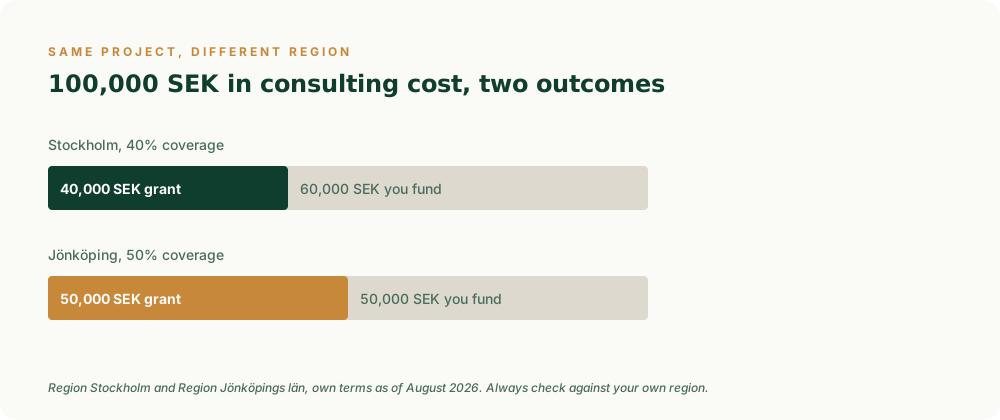
Region Stockholm's own worked example is direct about the split: a 100,000 SEK project gets 40,000 SEK in support, and the company funds the rest itself. Jönköping covers half instead of forty percent, so the same project gets 50,000 SEK. Neither region pays the full amount upfront, and neither reimburses the full cost afterward either.
What disqualifies an application
This is where most rejected applications actually go wrong, and it differs by region.
Region Stockholm excludes marketing and sales work outright. A project described as sales development, campaign work, or content production gets rejected regardless of quality. The same region excludes training courses, licence costs, and ongoing app or web development.
Skåne's wording is narrower. It only excludes general training unrelated to the specific project, which leaves room for competence transfer that sits inside a larger build, rather than a standalone course package.
The takeaway is simple to state and easy to miss when writing the application: describe what you're building, not what you're selling. A project that structures a company's knowledge and processes reads completely differently to a caseworker than the same project described as a sales tool, even when the underlying work is identical.
How the application actually works
Applications go through Almi in your region. Two things surprise most first-time applicants.
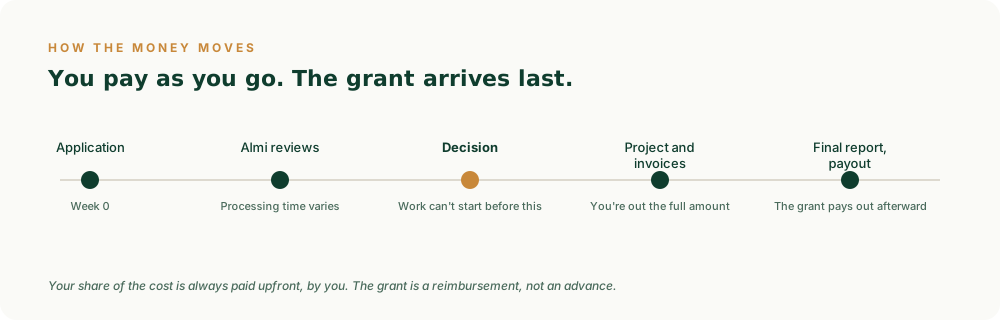
You can't start the work before the decision arrives. A positive decision that lands after the invoice is already paid doesn't count.
The grant pays out afterward, against documentation. You cover the full cost yourself as the project runs, submit invoices and a final report, and your share comes back after that. Expect weeks, sometimes months, between application and first payout.
What you can actually build with it
The problem this grant solves best isn't messy documents. It's that the most important things at your company were never written down at all. They live in the head of whoever built the business, in a form neither a new hire nor an AI agent can use.
That happens to be exactly the kind of project the regions themselves call eligible: digitalising business processes, building new services out of structuring existing data, automating internal workflows. We've built this for companies like Sakura, where the result is one knowledge base that employees and AI agents can both work against, instead of documents scattered across tools nobody checks.
Stockholm versus Jönköping, side by side
| Stockholm | Jönköpings län | |
|---|---|---|
| Coverage | 40% | 50% |
| Max grant | 200,000 SEK | 150,000 SEK |
| Project cost | Roughly 125,000 to 500,000 SEK, derived | 100,000 to 300,000 SEK |
| Employees | 2 to 49 | 2 to 249 |
| Turnover | 1 to 100M SEK | 2 to 500M SEK |
| Application window | Limited, check current dates | Rolling |
| Administered by | Almi, then the region | Almi Jönköping |
The other nineteen regions run their own versions of the same scheme. The underlying structure holds, but coverage, caps, and windows vary. We're adding regions as we verify them. Tell us which one you need, and we'll prioritise it.
The grant requires an external supplier. We're that supplier.
Book a free call, we'll check whether your project qualifies and build it if it does.
Book a callJoin the newsletter.
A weekly summary of new insights, plus what's new at Opmore. No spam, just insights.