I recorded this one on Day One of Future Talent Forum Malta, the late morning keynote titled "Beyond Units of Productivity: Human Flourishing, AI and the Future Company." Two speakers, one talk. Luke McKeever, CEO of Thomas International, opened it. About twenty minutes in he brought Adrian Furnham, professor at BI Norwegian Business School, up on stage to finish it. Furnham's bio, as McKeever gave it: 101 published books, 1,500 peer-reviewed articles, and in the psychometrics field, a good claim to having trained the people who built half the models the industry now runs on.
The talk had a clean shape. McKeever spent his half on where the money is going and why that should worry you. Furnham spent his half on the one thing he thinks protects people from what the money wants. Here's both halves.
The money doesn't want what you want
McKeever's opening move was to follow the capital. By 2030, he said, invested capital in AI infrastructure, chips, data centers and energy will be north of $6 trillion. That money is not patient. It's annualized, expecting a return somewhere between 29 and 40 cents on every dollar, every year, for the investment to be worth making.
So where does that kind of money aim itself? "The answer is human efficiency," he said. Doing what people do, but faster, cheaper, and without a salary. His line for it: "It's diametrically opposed to the needs of us as humans."
He walked through the history to argue the trajectory doesn't reverse even when the money does. UK railroad crashes in the 1840s. More in the US in 1853, 1857, 1873 and 1893. The dotcom crash, which he lived through personally, having IPO'd a business the day before the market ran dry. "You couldn't give it away a day later." His point in each case: the crash wipes out the speculative capital, but the infrastructure stays built and the adoption sticks. A bubble popping doesn't undo the railroad. He expects the same for AI. Whatever happens to the money, the shift is already locked in.
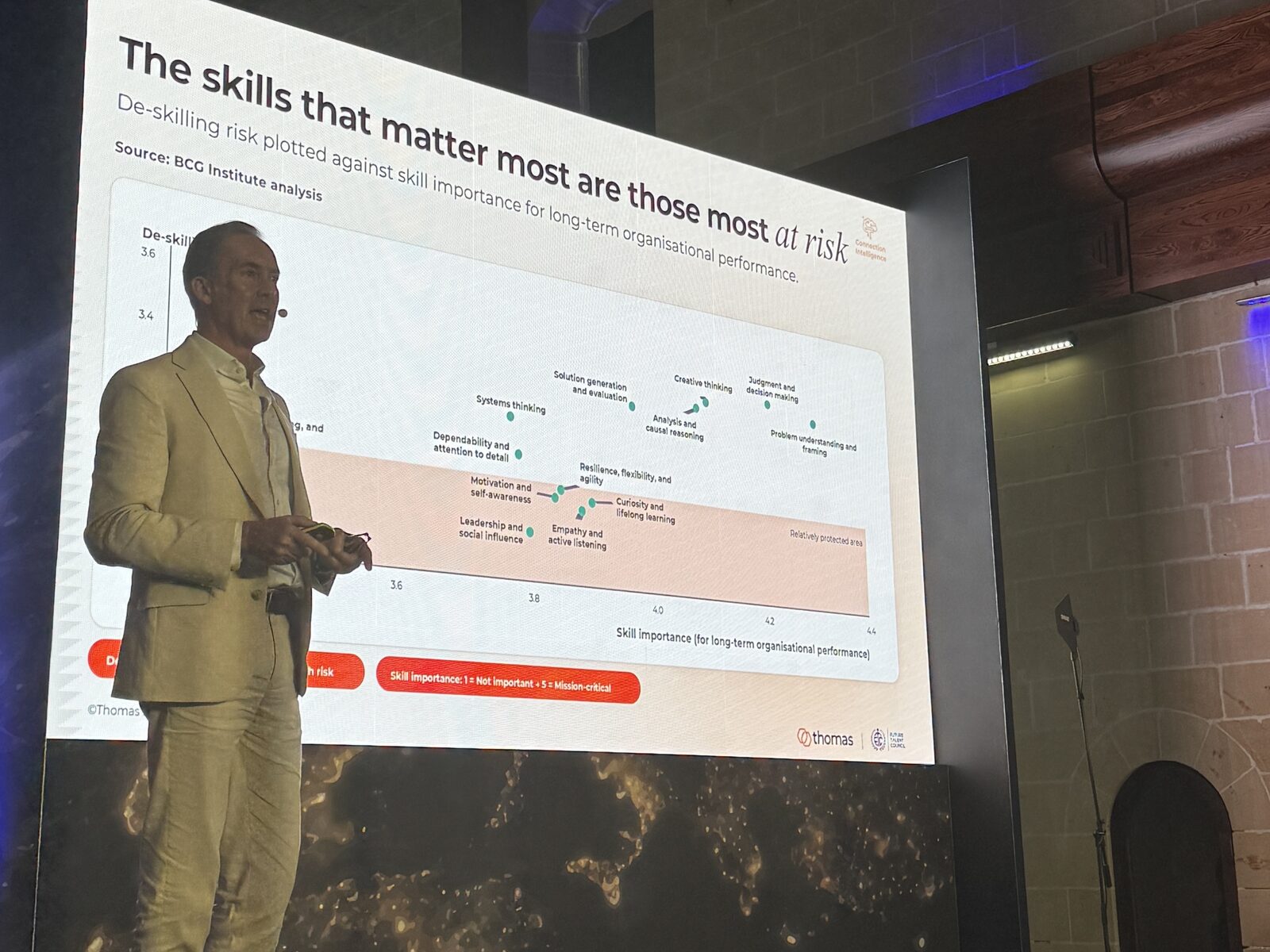
He also cited research from Boston Consulting Group, published in August, that mapped skills on two axes: how likely they are to be de-skilled by AI, against how important they are to a business's long-term survival. The finding he pulled out is the uncomfortable one: judgment, decision-making, analysis, creative thinking and problem understanding, the skills that keep a business alive over time, are also the ones most exposed to being handed off to a tool. That's the pairing behind the slide on this post's cover: the skills that matter most are the ones most at risk.
McKeever was careful not to make this a story about soft, empathetic, adaptable people winning and everyone else losing. He said the opposite from thirty years of running AI projects: his strongest contributors are rarely the agile, dynamic, change-embracing type the narrative expects. "They're slower, they're considered, they're methodological, they're skeptical." He argued that a room full of people like him would get nowhere, all conversation and no delivery, and that the skeptics and the methodical are the ones who keep a project honest.
He closed his half with something more personal. He described building his own AI advisory board, tuned to his ikigai, that he says has become genuinely useful to him. He's 57, and near the end of his career, so offloading some thinking to it "fills me with a bit of glee." Then the question he left hanging for the room: if you're 21, and you start offloading that early, what do you become at 25, 30, 35? How strong is your judgment by then?
Furnham's answer: connection
Furnham opened with a line from Freud, translated on stage as work and love, those two things being what a person needs to flourish. His question for the room was narrower: what kind of work, in an AI period, actually delivers that.
He started with a mechanism he called ASA theory, attraction, selection, socialization, attrition, for how organizations end up so alike. People are drawn to a role, selectors check whether they look and sound right for it, the organization socializes them further into the mold, and anyone who doesn't fit eventually leaves. The result, he said, is that you can often tell what department you're talking to within five minutes, because homogeneity is that visible. He called it an enemy of lateral thinking, and drew a line between skepticism, which he wants more of, and cynicism, which he doesn't.
His word for the rest of the talk was connection. Not engagement, which he thinks companies have been chasing with the wrong instrument for years, running surveys and reporting a 2 percent dip to the CEO without ever asking what actually drives the number. His argument is that engagement is downstream of connection, and connection is measurable on its own terms.
He laid out five states people can be in: connected, unconnected, disconnected (once connected, then dropped), intermittently connected, or, the state he wants, "very well connected." Airline pilots, he said from his consulting work, rarely reach that state, because the job itself, planes and hotels and back again, never gives them the chance.
The line I kept coming back to: connection runs from the heart to the head, not the other way. "Look at the great speeches of the world. They hit you here, and the message goes from the heart to the head." He told a story from a management course he taught years ago, about a manager who required his team, eight to ten people, to leave the office together on the last Friday of every month and stay together until 5pm, doing whatever they wanted. Movies, swimming, tennis, it didn't matter. Over a year, people who didn't necessarily like each other learned what the others actually cared about. Furnham's point was that this one rule, repeated monthly, did more for the team than any leadership course he'd run.
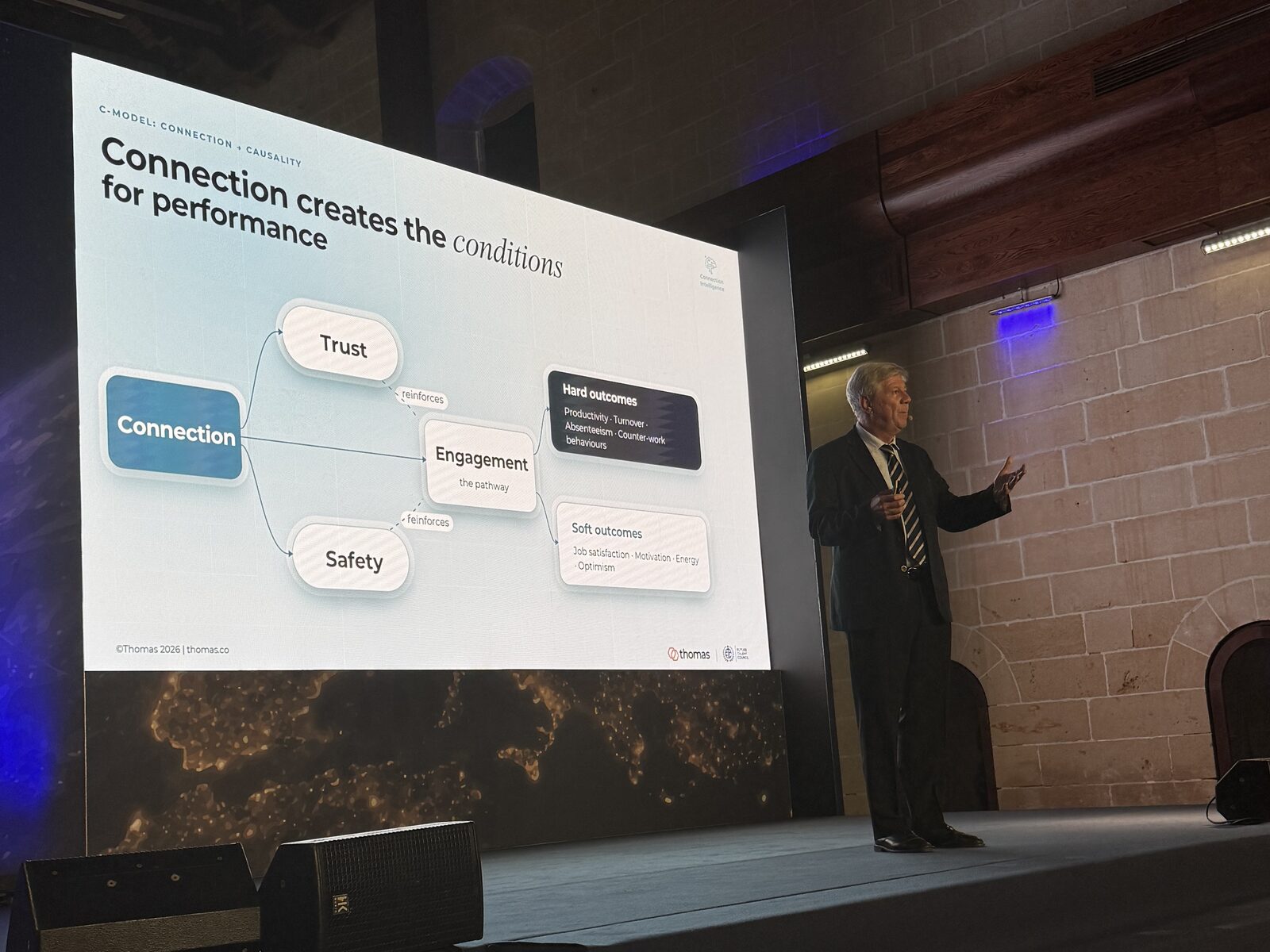
He built this into a chain: capability leads to connection, connection leads to engagement, and engagement produces two things companies actually measure, discretionary effort and commercial output. He named six components that make up connection: trust, belonging, appreciation, meaning in your contribution, well-being, and cohesion. His group has built a way to measure all six.
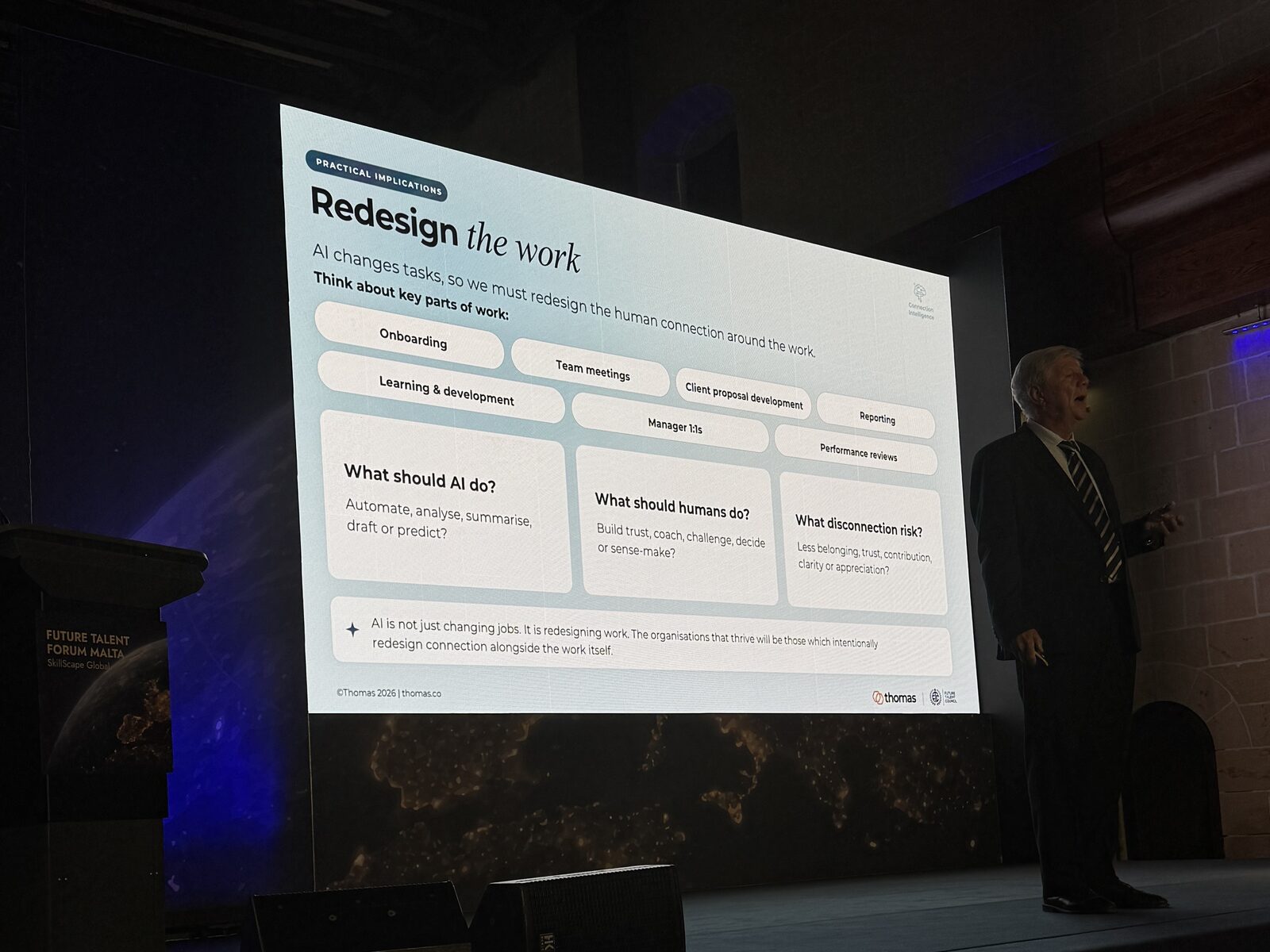
Then he tied it to AI directly. Without connection, he said, employees stop challenging what a tool gives them back. With it, people adopt tools with more confidence and learn faster from them. The slide he and McKeever showed here mapped four places in a company where this plays out: onboarding, team meetings, manager one-on-ones, and performance reviews, each with a line for what AI should do, what a human should do, and what gets lost if you get that split wrong.
McKeever closed the session by citing longitudinal research across the FTSE 250 and the Fortune 500, correlating connection scores against financial performance. He said the correlation was strong, and left the detail for the deck the QR code pointed to. His last line to the room was the whole talk in one sentence: decide what AI is genuinely best at, keep the human at the center instead of the AI, and measure the thing that actually matters, which is whether people flourish, not just what they output.
What this means for a new hire's first week
The onboarding line on that slide is the one I wrote down hardest. A new person's first weeks are exactly where connection gets built or lost, and most companies hand a new hire a login and a stack of documents instead of the thing Furnham described: trust, belonging, and a sense that their contribution means something. That's a connection problem before it's a knowledge problem. The reason Opmore exists is the belief that people arrive productive faster when they arrive already onboarded, not just handed a manual. Furnham would say the manual was never really the point.
Talk to us about your project.
Book a callJoin the newsletter.
A weekly summary of new insights, plus what's new at Opmore. No spam, just insights.