Partnerships that work start with the problem, not the paperwork
By Mohammed Alsaadi
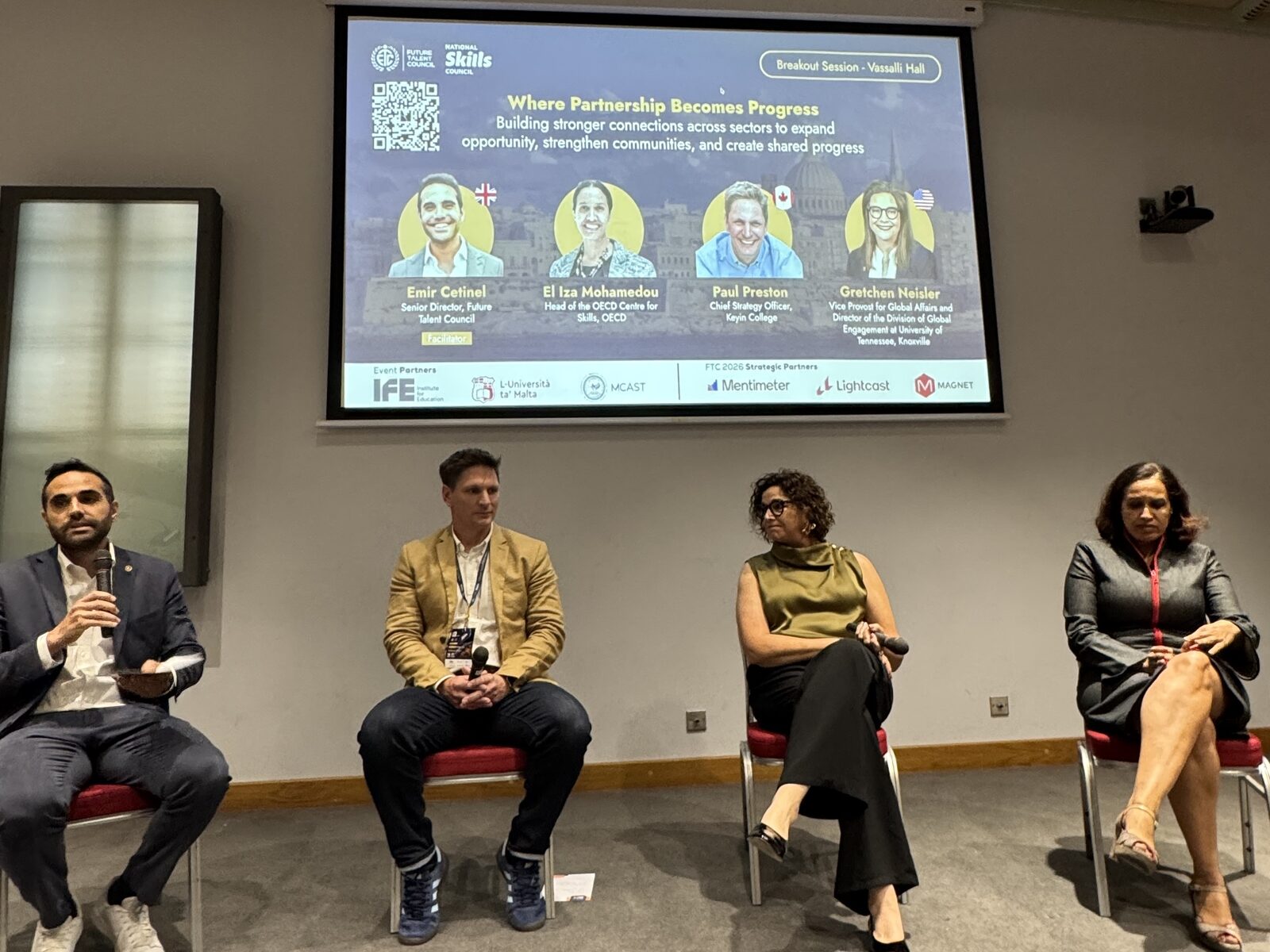
This was the Thursday morning breakout, "Where Partnership Becomes Progress," and it drew a full room. Three people who build cross-sector partnerships for a living, Gretchen Neisler (Vice Provost for Global Engagement, University of Tennessee, Knoxville), El Iza Mohamedou (Head of the Centre for Skills, OECD) and Paul Preston (Chief Strategy Officer, Keyin College), with Emir Cetinel of the Future Talent Council moderating. He opened by tying the session to a line from an earlier one that morning: partnerships fail when you start by signing an agreement and figure out the problem afterward. That was the case he referenced, a project that ended up costing a hundred million dollars because nobody had agreed what problem they were solving before the ink dried. The whole hour circled back to that one idea from three different angles.
Start with the problem, not the agreement
Gretchen Neisler went first. Her work in Rwanda started in 1996, as a graduate student, and followed her through Michigan State to Tennessee, where she opened the network to her own faculty. Her core belief runs against the usual advice: most people will tell you a partnership is held together by one relationship between two people. She thinks that is a trap for a large research university. It has to be institutional, or it dies the day that person leaves.
At UT Knoxville, six colleges now run active partnerships in Rwanda, on six different problems. The method was to go listen to Rwandan colleagues first, learn what they were actually prioritizing, then go home and look for where Tennessee's own strengths lined up with those priorities instead of duplicating them. As a land-grant institution, every UT faculty member already has to teach, research, and serve the public, so the university's own mission points the same direction as the partnership work.
Two ways to bring small companies along
El Iza Mohamedou's contribution was two contrasting models, both aimed at the same problem: small and medium companies make up 90% of businesses in the European Union, but adoption of things like AI happens mostly in the companies with more than 100 employees. Only around 17% of SMEs have adopted it.
Skillnet Ireland's answer is aggregation. Instead of every small company trying to solve a skills gap alone, Ireland groups them by sector and by region, and runs training and skills diagnostics at that level. A single SME has no voice on its own. A sector does.
Singapore's answer, which she called the Queen Bee model, is different: diffusion, not aggregation. Large companies like DBS and Bosch do not train the smaller firms around them directly. They mentor them, helping with skills diagnostics, showing them how to access government support, effectively becoming a big sister to potential competitors. It sounds strange until you see it work inside a small, tightly connected ecosystem, and Mohamedou pointed out that neither model transplants cleanly. Malta is a compact ecosystem too, much like Singapore, but what works there depends on a collaborative culture that took years to build and cannot simply be copied in.
From a Chattanooga plant floor to a Rwandan field
Neisler's second story was the one the room kept coming back to. Volkswagen built its North American headquarters near Knoxville and later put a research institute on UT's own campus, working across departments most people would not expect, including the Institute of Agriculture. One of those faculty members built a liftgate for Volkswagen's electric vehicle out of plant biomass to cut the vehicle's weight. It is now manufactured and installed in the cars.
From there the relationship grew on its own. Volkswagen started sponsoring graduate students who work with UT faculty and then show up in Chattanooga to help translate the research into the plant. A student exchange opened with Volkswagen's German headquarters. Volkswagen's existing collaboration with the University of Sheffield became a research link with UT too. And last year, when Volkswagen's e-hub outside Kigali had tractors sitting broken, engineering students from three universities retrofitted them into electric tractors that now plow local farmland as part of a community program. Cetinel put a number on the output: around 30 research projects and roughly 14 or 15 patents out of the partnership so far. Neisler's own reading of it was blunter: universities are bad at telling this story, because most scientists would rather do the work than talk about it.
Atlantic Canada's math problem
Paul Preston's version of "start with the problem" was demographic. Atlantic Canada has the oldest population in the country, with six times more people leaving the workforce than entering it, and a birth rate around 1.4 against the roughly 2.1 needed just to hold population steady. Immigration helped, but was never going to close that gap alone.
Keyin College's response was a win-win-win model: co-create with industry, academia and government together, rather than build something and hope it lands. That approach opened sector-specific funding for manufacturing, energy, and tourism, and produced around 10,000 AI-curated micro-credentials tailored to the sectors they serve. A newer, unannounced project trains hundreds of paramedics over three to four years, using an AI tutor named Norman that adapts to how each learner best takes in material, and a companion tool called Fetch that flags anyone who missed a class and helps them catch up. The healthcare partnership's net promoter score sits at 93%. Preston was equally direct about the price of radical transparency: dashboards built with AI are shared live with partners and with government, the same real numbers an executive would see.
What breaks a partnership
The panel's most useful stretch was about failure, and nobody dodged it. Preston described walking away from a partnership six weeks earlier, affecting hundreds of businesses, over intellectual property rights that were never nailed down before the work started. It was a repeat partner, so the earlier success bred confidence that skipped the legal groundwork. His conclusion: know your non-negotiables before you start, not after.
Neisler's failure was internal. Her team found that partnership agreements at UT took an average of 284 days to clear approval, even for zero-dollar contracts, and the university had actually given back grants because the paperwork could not be signed in time. She went to the chancellor and asked for signing authority on the zero-dollar agreements herself, so faculty could move at the speed their work required. Her framing: before you hold anyone else accountable for being a bad partner, check whether your own institution is one.
Mohamedou added two more. A partnership that stalled for years because a country's polite hesitancy was read as eventual agreement, when it had actually been a no from the start. And a federal-state data partnership that fell apart when states wanted to be paid to share performance data, once they realized what the data might reveal about them. Her closing point was the least glamorous and probably the truest: partnerships survive on project management. Who does what, who updates the plan, who notices when it drifts. Nobody wants to own that part, and it is the part that keeps everything else alive.
From one relationship to an institution
An audience member asked Neisler how she moved a single personal relationship into something the whole institution owns. Her test: if she disappeared tomorrow, does the work keep going? She described a moment where her own university leadership started throwing up roadblocks on the Rwanda project mid-stream, despite having approved it, and realized the fix was not more paperwork but getting them physically on the ground. In October, UT is sending its provost to Kigali to see the work firsthand, deliberately not traveling with the chancellor at the same time.
I asked the last question of the session myself, about the gap between education and the workplace, and what it takes to partner with both employers and universities at once to get new people into real jobs with real experience. Preston's answer was that Keyin curates every program by matching labor market and industry association data against the skills already in their population, and by leaning on funded internship and near-apprenticeship pathways that let an employer test someone before committing to hire.
What this means if you are the one building the bridge
Nothing on this panel was about technology. It was about who owns a problem long enough to see it through, and whether a partnership can survive the person who started it moving on. That is the same question a company faces every time someone new starts a job. The knowledge of how the role actually works usually sits in one person's head, and if that person leaves before it gets written down, the next hire starts from zero. A role playbook is the same fix Neisler applied to her own university: get what one person knows out of that one person, and into something the institution owns, before you find out the hard way that it never left their head at all.
Talk to us about your project.
Book a callJoin the newsletter.
A weekly summary of new insights, plus what's new at Opmore. No spam, just insights.