Monika Bielskyte: fantasy salesmen should not be prophets
By Mohammed Alsaadi
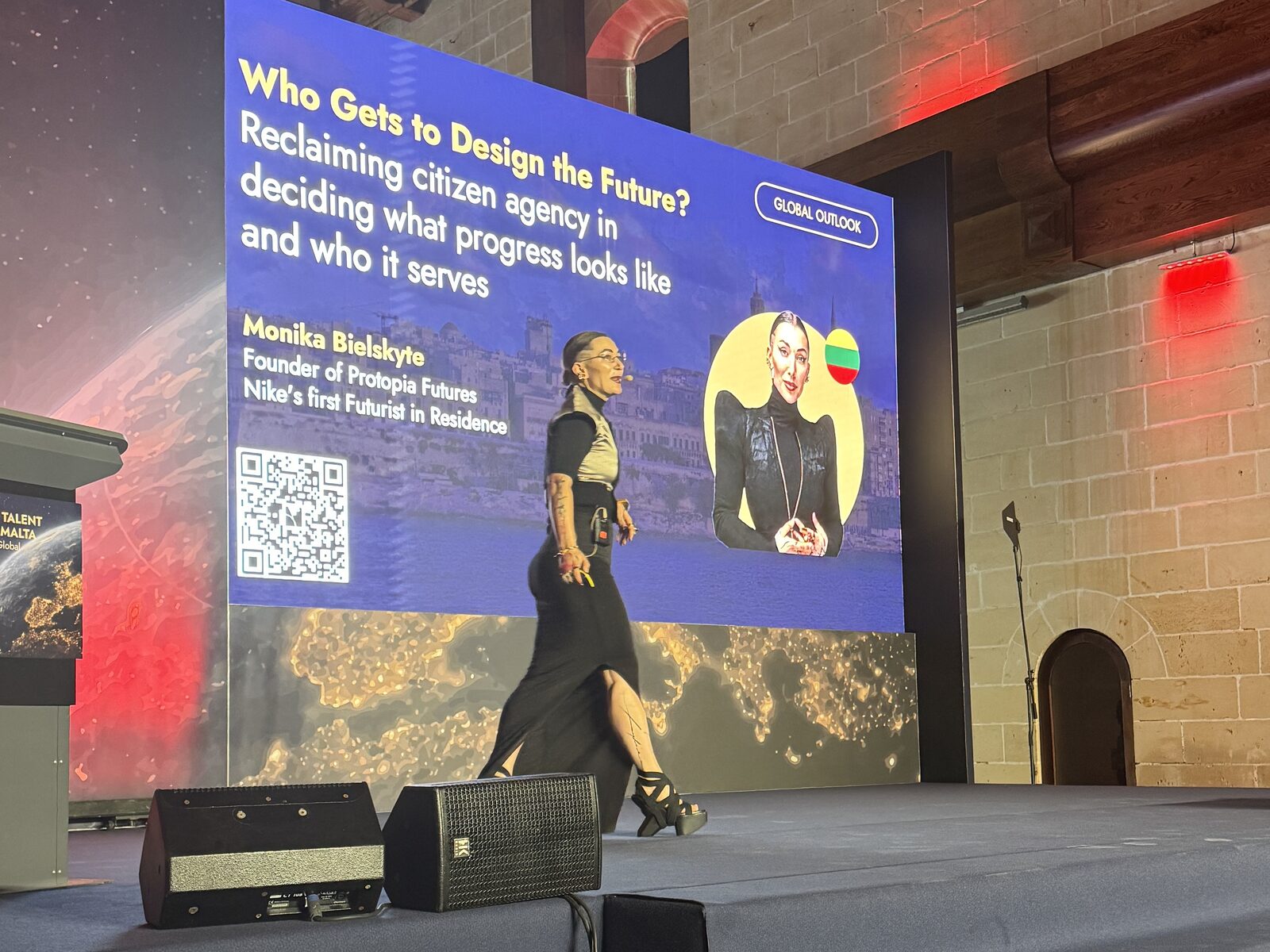
Right before lunch on Day 1, the room got the closing keynote for the morning: "Who Gets to Build the Future?" Monika Bielskyte is the founder of Protopia Futures and was the first Futurist-in-Residence at Nike. She opened by explaining what she is not. Not a fortune teller, not somebody who can tell you your future, and not, in her words, "into space and mind-uploading and sci-fi." She works at the intersection of science, technology and innovation, and she is deeply interested in science fiction, but mostly from a critical angle: how it has quietly written the plans that trillion-dollar companies are now executing.
This was the talk I wrote the most down from all day.
Fantasy salesmen, not prophets
Her central example was Elon Musk and Mars. Not as a jab at one person, but as a case study in how a story gets mistaken for a fact. Musk describes a future of Mars settlement, and because he says it with confidence and a track record of real rockets, it gets treated as prophecy instead of salesmanship. Her line: "Fantasy salesman should not prophecy."
She walked through the mechanics of it. The pitch starts modest, data centers in space, then a base on the Moon, then a city on Mars, then the galaxy. "The story inflates the valuation, the valuation inflates his wealth, and his wealth returns as proof that the story must be true. Rinse, repeat." The rockets are real. The engineering is real. But the underlying premise, that humans can live on Mars, rests on science from the early and mid-20th century, when people still believed the planet had irrigation canals. The best available science today says the human body cannot survive there. Better rockets do not fix that. The body is the problem, and no amount of funding changes the atmosphere or the gravity.
Her point was not really about Mars. It was about who gets to set the fantasy that everyone else then has to live inside. "Those who control the fantasy control the future," she said, and the people doing the controlling are, in her telling, the ones whose imagination froze at whatever sci-fi film they watched as teenagers, now backed by billions of dollars and insulated enough from consequences that nobody tells them no.
Neither dystopia nor utopia
She was just as hard on the opposite failure mode. Doom-and-gloom futurism that says nothing can be done, and techno-utopianism that says a vision is so perfect it cannot be questioned, are two versions of the same trap. "Every historical utopia has been somebody else's dystopia," she said, and that includes today's.
Her answer was to follow the science over the hype, always. She quoted Mark Carney's line that nostalgia is not a strategy, then went further: "Nostalgia is poison." So is the opposite instinct, treating every new technology as inherently transformative. When she gets an uncomfortable, inconvenient result that questions an existing assumption, that is not a threat to work around. That is the actual work of thinking about the future, because reality does not adjust itself to fit an ideology.
AI is an amplifier, not a change maker
She spent real time on where AI actually sits in this picture, and it was the most practical stretch of the talk. Her framing: technology does not create culture, it absorbs it. "AI, just like all the previous technologies, is an amplifier, not a change maker. It is anchored in culture that created it, it is anchored in culture that it absorbs. Bullshit in, bullshit out."
She pointed to what she called AI cannibalism, models trained on more and more of their own synthetic output, a process the writer Cory Doctorow calls enshittification. She also borrowed two more of his terms that stuck with me. A centaur is a human assisted by a machine, where the pairing does more than either could alone. A reverse centaur is the machine in charge and the human reduced to what she called a meat puppet, a phrase she said has been circulating on LinkedIn. The difference between the two is not whether you use the tool. It is whether you keep your own capacity to question it, to notice where it hits its limits, and to push back.
She was careful not to land this as anti-technology. Refusing to engage with these tools at all is, in her words, a privileged position available mostly to people with cushy academic jobs. The tools exist and most people have no choice but to use them. Her objection is to accepting them exactly as they are designed and deployed, and to defaulting to a machine because reaching out to an actual person, a mentor, a colleague, a friend, feels inconvenient. "Interconnection, interdependence, ultimately is the strength of all biological and societal systems," she said. Push any body, or any organization, too hard toward pure output and you get something brittle. The redundancy and the roundabout paths built into it are what let it survive a hit.
The center is always late
The last stretch of the talk was about who gets consulted when these visions get built, and it was the sharpest turn of the hour. Her claim: the future is never actually decided top-down from Silicon Valley, London, New York and Dubai, whatever it looks like from the center. It is decided at the edge, among the people who feel the consequences first, and the center eventually catches up.
She gave two examples. The city of Johannesburg has run through grid shutdowns for years and kept functioning, because the systems around daily life were never built assuming an always-on grid. When Portugal had its own shutdown last year, it hit much harder, because nothing had been built to absorb it. Same pattern with design for neurodivergent people. Environments built to reduce sensory overload for someone with extreme sensitivity turn out to help almost everyone, because the same triggers that cause a migraine or nausea in one person accumulate as damage in everyone, just more slowly.
Her framework for building future visions that actually hold up is something she calls the Protopia World Stack, three parts working together. First, does the vision survive contact with the best available science, or is it borrowed from old science fiction because that version is more comfortable. Second, embodied futures: how does this land in an actual body, does it support it or undermine it. Third, story world design: using the same narrative tools that made Mars colonization feel inevitable to make a real, evidence-based future feel just as compelling, instead of leaving it as a dry PowerPoint deck that loses to conspiracy videos on the same platform.
She closed on a question rather than a solution. What if the most futuristic thing available to us is not flying cars or space colonies, but being more present here, in this body, in this relationship, on this planet. Not because technology is the enemy, but because the interdependence that actually keeps a body, or a society, resilient is exactly what disappears the moment efficiency becomes the only goal.
What this means if you are building something
The part of the talk that stayed with me longest was not about Mars. It was the idea that whoever writes the vision first ends up shaping what everyone downstream treats as inevitable, whether or not that vision was ever checked against reality. Inside a company, the same thing happens at a much smaller scale. The founder's read on how the business actually works, who the buyer really is, what the pitch is supposed to sound like, becomes the story everyone new inherits, right or wrong, unless somebody writes down what is actually true and keeps checking it against what is really happening on the ground. That is the whole case for building a role playbook instead of letting each new person guess at the founder's story from the outside. Get the real thing down, from the people closest to the work, and keep it honest.
Talk to us about your project.
Book a callJoin the newsletter.
A weekly summary of new insights, plus what's new at Opmore. No spam, just insights.