Mark Patterson: The word isn't excitement or fear, it's sovereignty
By Mohammed Alsaadi
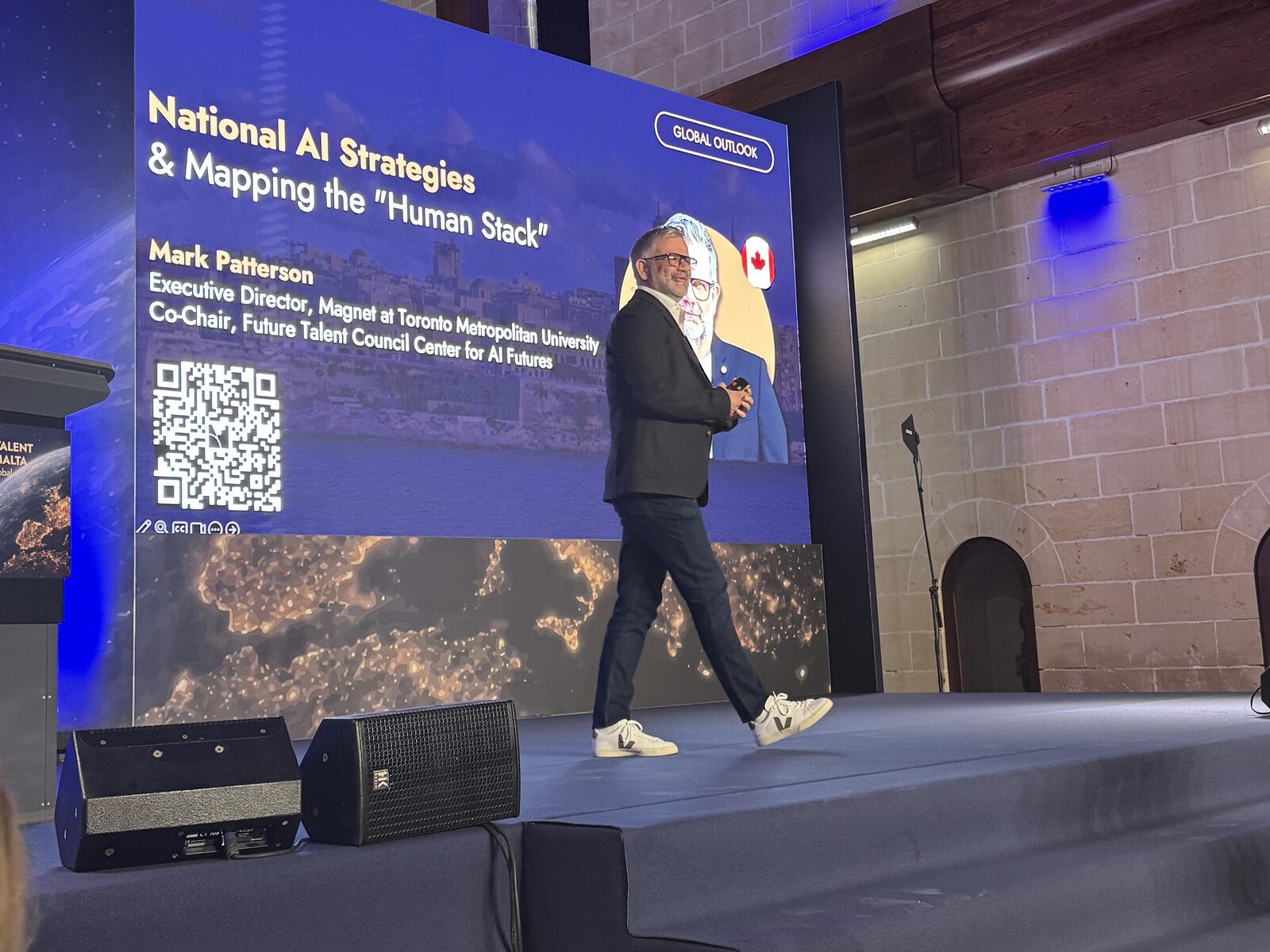
The first keynote of Future Talent Forum Malta was called National AI Strategies and Mapping the Human Stack, and Mark Patterson opened it with a question he asked the room to sit with for the whole talk, not just his twenty minutes. As AI gets more capable, who gets more capable with it?
Patterson is Executive Director of Magnet at Toronto Metropolitan University and Co-Chair of the FTC Center for AI Futures. He has been involved with the Future Talent Council for years, and he framed the question as personal before he made it national. How will AI change his own career. How will his university adapt. How will Canada adapt.
The word he kept landing on
He has given a lot of AI talks in the last few years, and he always opens the same way. He asks the room, in their own heads, for the one word that comes to mind when they think about the future of AI. The answers split. Some people are excited about what AI can do. Some are scared. Most, he said, are both at once, depending on which part of the question they are looking at.
But after enough of these sessions, one word kept surfacing for him that wasn't excitement or fear or uncertainty. It was sovereignty.
What that means for a country
Patterson is Canadian, and he was blunt that this is not really about the trade war or tariffs with the US. It is about sovereignty. He walked through how Canada ended up exposed: decades of building trade infrastructure north and south into the US because it was simpler, rather than east to the coast where oil and critical minerals could reach Europe. He quoted Canada's prime minister speaking at Davos: "We cannot live within the line of the mutual benefit of integration if that integration becomes a source of our subjugation."
He tied that directly to AI. Frontier AI is built mostly by two companies in one country, and every day more of Canada's data, and every country's data, flows into that infrastructure. He gave a specific number: if he emails someone in the next province over in Canada, there is a 70 percent chance that email routes through the US, because the two countries' digital infrastructure is that integrated.
The example he holds up as the alternative is Arizona State University. A couple of years ago ASU built an infrastructure with more than 50 large language models plugged into it, with the institution controlling the data, privacy and security itself. Because they trusted how the data was being handled, they could build sandboxes on top of it and let people experiment. He called it one of the most advanced AI adopters in the world, and the reason wasn't picking the best model. It was building infrastructure that stayed vendor agnostic, so no single provider owned the institution's data.
He wants versions of that model built out across Canada: local and Canadian sovereign models sitting alongside access to frontier AI when it is actually needed, plus what he called adoption infrastructure aimed specifically at small and medium businesses, which make up close to 90 percent of the Canadian workforce against roughly 50 percent in the US.
What sovereignty means for one person
Then he brought the same word down to the individual level. Am I outsourcing my own thinking to AI. Am I de-skilling. He used the terms cognitive offloading and cognitive surrender, and said he checks himself against them constantly, not because he is against AI (he uses every major model daily) but because he goes in with his eyes open about what handing over that much personal data actually costs.
His own test for that: he asked ChatGPT how it thinks he votes. It was exactly right.
He compared it to banking. He keeps money in four different banks rather than one. He treats his data the same way, spreading it rather than handing everything to a single AI provider.
The line that stuck with me most was about identity. He said most people in most countries have built their sense of self around a technical skill or a credential. A computer science graduate calls himself a software developer, and right now that feels genuinely threatening, because the job title is the thing being automated. His advice, to individuals and to organizations both, is to root your identity in a mission or purpose instead, and treat the technical skill, including AI itself, as a tool that amplifies that purpose rather than defines you.
Training people is not the same as helping them use it
Patterson said that back in 2022 and 2023, if you had asked him what mattered most, he would have said AI literacy. He still thinks literacy matters. But skills alone are not enough. What he is focused on now is absorption, whether individuals, organizations and whole societies can actually take the technology in and build with it, rather than just be trained on it and sent home.
He quoted David Sachs, the Trump administration's AI czar, saying at the start of the term that AI would be a million times more powerful by the time that presidency ends than it was at the start. Patterson's read: we are ahead of that schedule.
Canada has spent real money on reskilling and upskilling, he said, and far less on helping organizations actually absorb and use those new skills once people bring them back to work. Training someone and hoping they change their workplace on their own is not a strategy.
Why he closed on this
His closing question circled back to the opening one. What will people become more capable of, because of the decisions you make, whether you run a skills agency, a university or a business. And his last line was the one I wrote down word for word: he believes the decisions made in the next two years will determine the next five decades.
What it means for anyone starting somewhere new
Patterson's argument was about countries and about individuals choosing what they hand over versus what they keep, but the same test applies to any new hire walking into a company on day one. The people who actually get more capable are the ones with real access to how the place works, not just a login to whatever AI tool is on the desk. A new person handed a chatbot and no context about how their company actually does its work is exactly the version of cognitive offloading Patterson was warning about. Giving someone the judgment and the context a company has built up, in a form they can actually use in week one, is what makes the AI tool worth anything at all. Without it, the tool just fills the gap with confident guesses.
Talk to us about your project.
Book a callJoin the newsletter.
A weekly summary of new insights, plus what's new at Opmore. No spam, just insights.