Four leaders on what actually turns policy into practice
By Mohammed Alsaadi
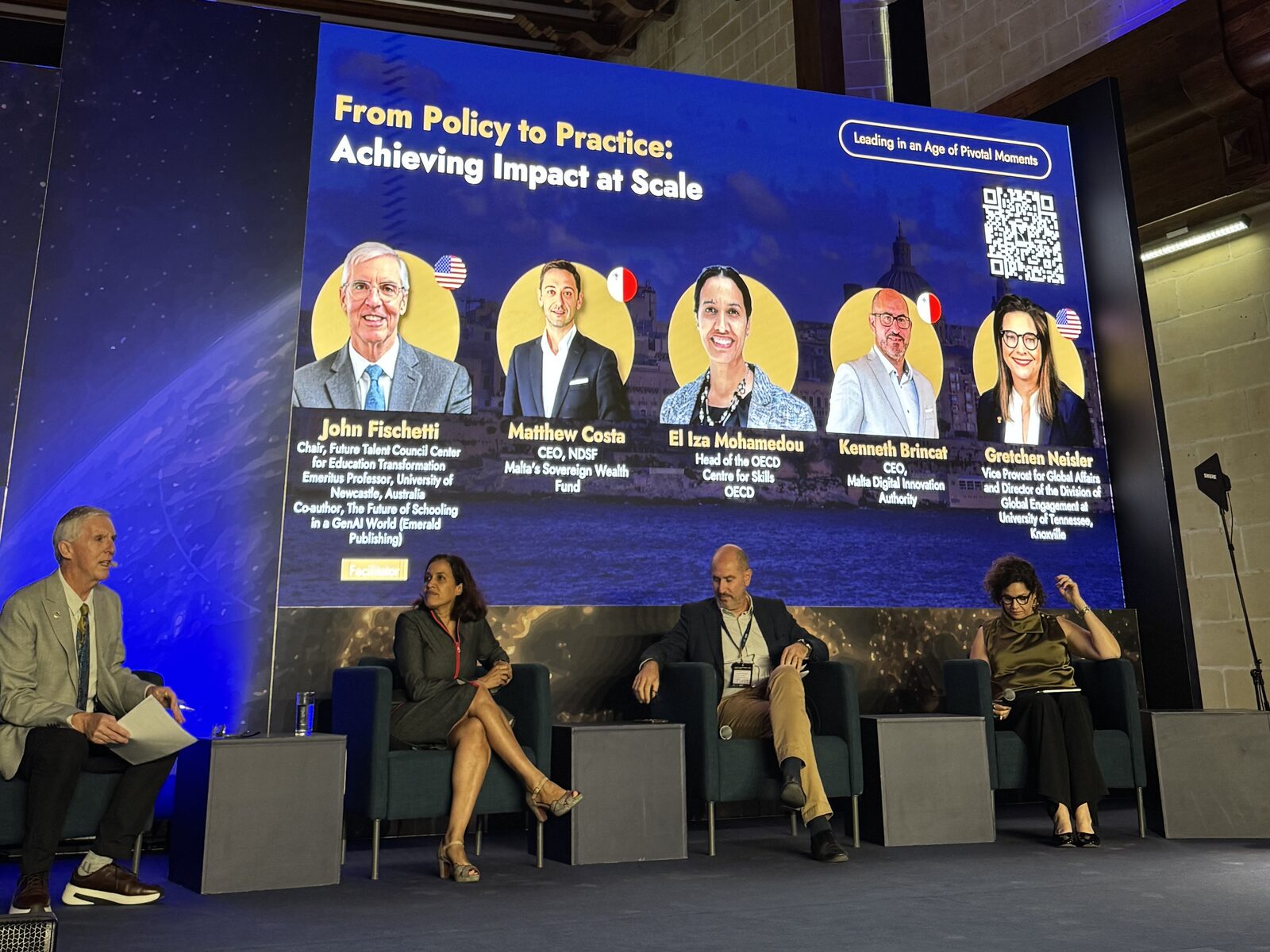
Day two opened with a panel built to answer one question directly: how does an ambition on a page actually become something a real person experiences differently. John Fischetti, Chair of the FTC Center for Education Transformation, facilitated. On stage: Matthew Costa, CEO of NDSF, Malta's Sovereign Wealth Fund. El Iza Mohamedou, Head of the Centre for Skills at the OECD. Kenneth Brincat, CEO of the Malta Digital Innovation Authority. Gretchen Neisler, Vice Provost for Global Engagement at the University of Tennessee, Knoxville. A fund, a policy body, a regulator and a university, all answering the same question from a different seat.
Fischetti set the test up front. Not how many strategies or action plans a country can point to, but whether someone, a learner, a worker, a small business, experiences a system differently because of them.
Partnership means delivery, not a seat at the table
Mohamedou's first example was a Dutch vocational education initiative called Katapult, which pairs VET teachers directly with employers across more than 150,000 staff and 40,000 new teachers. What made it work, in her telling, wasn't the size. It was that employers didn't just advise on the training, they delivered it and put money behind it, and students produced work back for the companies in return. Money changing hands is what turns a partnership from a conversation into a commitment.
She came back to the distinction later in sharper form: consultation is not partnership. Bringing employers to a table and asking what skills they need doesn't mean you've built anything with them. Her fix is procedural. Start with a small group focused on the actual problem rather than trying to seat every stakeholder at once, widen the circle in a second step, and check in on whether it's working along the way instead of waiting for a final evaluation to find out.
Fund the person, not the idea
Asked how NDSF decides what to back, Costa didn't describe a scoring model. He said that when he's being pitched, more often than not he's really being pitched a person, and the person behind an idea matters more to him than the idea itself. Plans change once you're actually inside a project, markets shift, requirements move, but the person driving it is the constant. Sector fit still matters, and NDSF weighs alignment with Malta's sustainable development goals and its national vision, but the first filter is who's carrying it.
What it takes to turn ambition into infrastructure
Costa's other example came from before NDSF, when he spent six years as CFO of Malta's national water utility. Water scarcity was the acknowledged problem and the investment ambition was clear, but the constraint was financing it sustainably. In 2023 the utility led Malta's first green bond issuance on the Malta Stock Exchange. Getting there meant upgrading internal governance to make the organization credible to capital, and it meant changing the regulatory environment to allow it. His point was that a green bond isn't just a capital markets transaction, it commits you to measuring your impact and your KPIs on an ongoing basis, which is what let the utility keep making the case for more investment afterward.
Malta's AI literacy push
Brincat's example, from MDIA's role advising the government on Malta's national AI strategy, was a public AI literacy course built as part of the country's AI action plan, with a completion incentive attached to encourage people to finish it rather than just sign up. His framing of the win wasn't the course itself. It was that people wanted to understand AI beyond how to use it, including the risks, and that the incentive got people who might not otherwise have bothered to actually complete it.
He returned to the same theme when asked how ordinary people and small businesses feel the benefit of a national AI strategy. Malta's original 2019 strategy treated AI mainly as an economic driver. The strategy has since been revised, not because the ambition changed but because the technology, the society and the businesses around it did. The current framing puts deployment through businesses and people first, with economic growth as the result of that rather than the direct target.
Universities move at the speed of their partnerships
Neisler's example was a faculty development program at the University of Tennessee called the Academy for Global Engagement, built for academics who wanted to build an international research portfolio but didn't know how to start. A cohort meets monthly for a year, takes a trip to Washington, D.C. to understand federal funding mechanisms, and hosts an international collaborator on campus to make the first real partnership happen with support attached rather than cold. Sixty faculty have completed it, generating roughly $382 million in proposals submitted across 174 funding mechanisms, and pulling around $121 million back into the university's own funds for global work.
Asked how universities move faster generally, given how slow academia usually is, her answer was to bring outside partners into the actual work rather than keep them at the edge of it. As US federal science funding tightened, her university leaned harder into private sector partnerships, and the surprising part was what those partners actually asked for. Not more technical training. People who could communicate. That single request reshaped both the classroom and, eventually, the research side of the partnership too.
Equity has to be checked, not assumed
The panel closed on equity, and both Mohamedou and Neisler pushed past the easy version of the answer. Mohamedou framed unequal partnerships as a risk in themselves: when one institutional partner carries most of the weight, the arrangement needs a regular check on what each side is actually getting out of it, and whether the partnership is adding something that wouldn't exist without it.
Neisler's answer was more direct. Expertise doesn't track the size of an organization's budget, and partnerships need an honest conversation about who gets recognition and who carries the risk, especially when one partner brings far more resources than the other. She described running a scholarship program with schools in South Africa that her own university's legal team resisted at every step, demanding extensive approval before it would proceed. It went ahead anyway, and by her account it changed people's lives. Her point wasn't that caution is wrong, it's that risk aversion has a cost too, and institutions rarely count it.
Costa closed on the same note from the funder's side. NDSF measures social return on its social investments the same way it would measure financial return elsewhere, checking against the specific goals it set at the outset rather than reporting a general sense of impact. Transparency about that measurement, he argued, is what lets social partners compete for support fairly instead of the loudest proposal winning by default.
Brincat had the line that closed the session, offered half as a joke. Asked before the panel what the most important skill of the future is, he said patience, then admitted it took him three months to land on that answer. AI tools reward it, he said, since half of them apologize before they get to the point.
What this means if you're the one building the thing
Nearly every example on that stage worked for the same underlying reason. Someone owned it by name, and the resources followed the person rather than the plan. A strategy with 150,000 people affected and one with a single new hire share that same mechanism. The knowledge of how something actually gets done rarely lives in a document. It lives with whoever is doing it, and it stays theirs until someone deliberately pulls it out and writes it down for the next person to use. That's the gap a role playbook is built to close: not another policy on a wall, but what a specific person needs to know, owned, written, and ready before their first week instead of assembled by accident over the following six months.
Talk to us about your project.
Book a callJoin the newsletter.
A weekly summary of new insights, plus what's new at Opmore. No spam, just insights.