What context does AI actually need to be good?
By Mohammed AlsaadiLäs på svenska
You've already tried it. Connected ChatGPT or Claude, maybe uploaded a handbook or a couple of documents, asked how you usually handle a particular customer or decision. The answer was fine. Right tone, reasonable structure, nothing outright wrong. It also could have come from any company in your industry.
The model isn't the problem. It never got the knowledge that actually makes your company different from the next one.
Four kinds of knowledge, one difference that matters
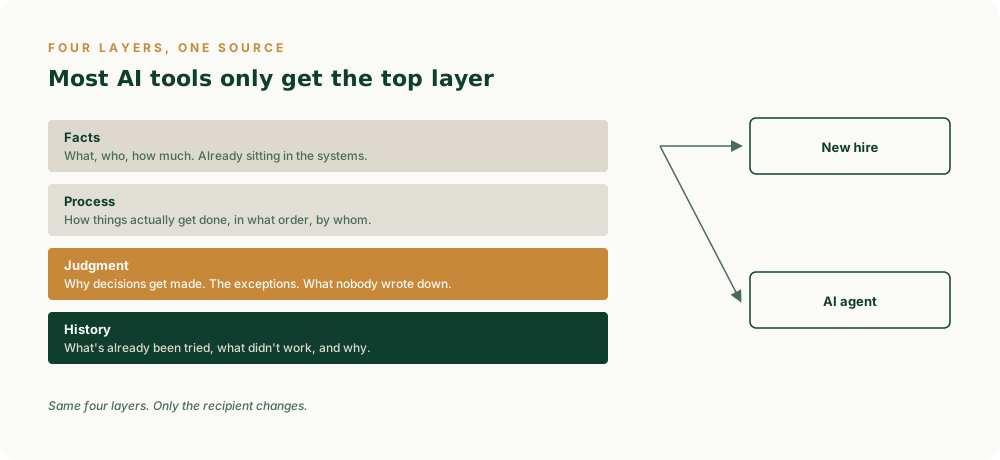
A company's knowledge splits into four layers, and most AI projects stop at the first one.
Facts. What you sell, who your customers are, what your prices are. Already sitting in the CRM, the invoicing system, the website. The easiest layer to pull, and the one AI tools usually get.
Process. How things actually get done. In what order, by whom, with which exceptions. Partly written down, mostly living in the head of whoever does the work.
Judgment. Why decisions get made the way they do. Why you turn down certain customers even when they have the budget. Why a specific objection gets handled a particular way. Almost never written down, because the person who knows it doesn't think of it as knowledge. It's just how things are done.
History. What's already been tried and didn't work. Which pricing got tested and pulled back. Which campaign flopped and why. The knowledge that stops you repeating the same mistake, and the one that disappears fastest when someone leaves.
An AI tool with access only to facts gives you facts back, formatted well. Ask it something that needs judgment, and it guesses from what's typical across the industry. Sounds reasonable. Wrong for you.
Why the last two layers never get written down
It isn't neglect. Whoever holds the judgment and the history is too busy using it to stop and document it. You notice the gap when that person is on holiday and everyone else guesses, or when someone leaves and nobody remembers why a specific exception exists.
The same gap that makes a new hire's first months slow is exactly the gap that makes an AI tool generic. It isn't two problems that happen to look similar. It's one problem, with two different recipients.
How you know you're missing it
Ask yourself three questions. Could a new hire, without asking anyone, explain why you do something a particular way instead of the obvious alternative? Is there an answer for why a customer who should fit your profile got turned down anyway? Would an AI answering a customer question in your voice say something you'd actually say, or something that just sounds plausible?
If the answer to any of those is no, it isn't a documentation problem. The knowledge never existed outside one person's head, and a better wiki doesn't fix that.
What actually fixes it
Structuring facts, process, judgment, and history into one shared source solves both problems at once, not as a side benefit but because it's the same build either way. An AI agent trained on that structure answers with your logic instead of the industry average. A new hire onboarded against the same structure stops waiting for someone to have time to explain.
Before you buy another AI tool, find out whether the problem is the tool or whether none of your four layers of knowledge exist anywhere a machine can read them.
Want to see what your AI is actually missing?
We'll walk through your four layers of knowledge and show what's gone. Book a free call.
Book a demoJoin the newsletter.
A weekly summary of new insights, plus what's new at Opmore. No spam, just insights.