What disappears when someone quits?
By Mohammed AlsaadiLäs på svenska
You can't always stop someone from leaving. Pay, a career move, a relocation, a better offer, it's rarely in your control. What you can stop is the knowledge leaving with them, and that's a different problem from the one you're usually trying to solve.
Most companies talking about turnover are talking about engagement: why people leave, how to get them to stay. Good question, wrong question for this. Whatever the reason someone leaves, voluntary or not, expected or not, the exact same thing disappears: the knowledge that was never written down.
What actually disappears
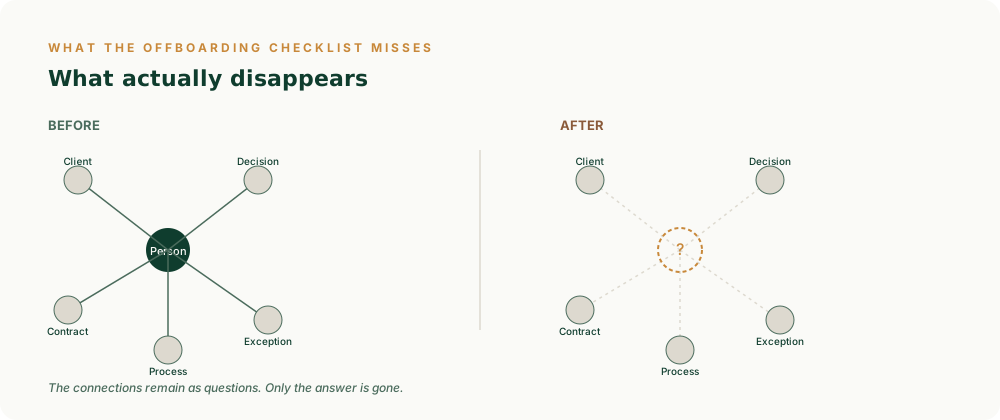
Not names and titles, those already sit in the HR system. What disappears is the judgment and history, the part of the knowledge that never lived anywhere except one person's head.
Which customers are sensitive about what, and why you handle them differently. Why a particular exception to the standard process exists, and what happens if someone removes it without knowing why. Which negotiations already ran and what's already been said. Who actually makes a certain decision, as opposed to whose title says they do.
Why it doesn't show up until it's too late
It doesn't show up as a number that drops. It shows up as a customer getting annoyed at being asked the same thing twice. A mistake that already happened and got fixed two years ago, now happening again, because nobody remembers why the fix looked the way it did. A decision that takes twice as long, because nobody remembers who used to make it quickly.
None of that shows up in an exit interview. Exit interviews come from the wrong end: they ask why someone is leaving, not what they're taking with them.
Capturing it at the right time
An exit interview is an attempt to reconstruct knowledge in an hour, from memory, under time pressure, from someone already halfway out the door. It rarely works.
What works is capturing the knowledge continuously, as part of how the work already gets done, not as a separate project triggered by a resignation letter. The same structured source that onboards a new hire is what makes the knowledge still there when an old one leaves. It isn't two processes. It's one structure, seen from two directions.
What this isn't about
It isn't about getting people to stay longer. Other tools are better at that, and it's a different question from this one. It's about making it irrelevant to the knowledge whether someone stays or not, because the knowledge already lives somewhere other than that person's head.
We build that structure for companies like Sakura.
Want to see what would disappear at your company?
We'll walk through what sits in which heads, and what you're at risk of losing. Book a call.
Book a demoJoin the newsletter.
A weekly summary of new insights, plus what's new at Opmore. No spam, just insights.