Writing for both humans and machines
By Mohammed AlsaadiLäs på svenska
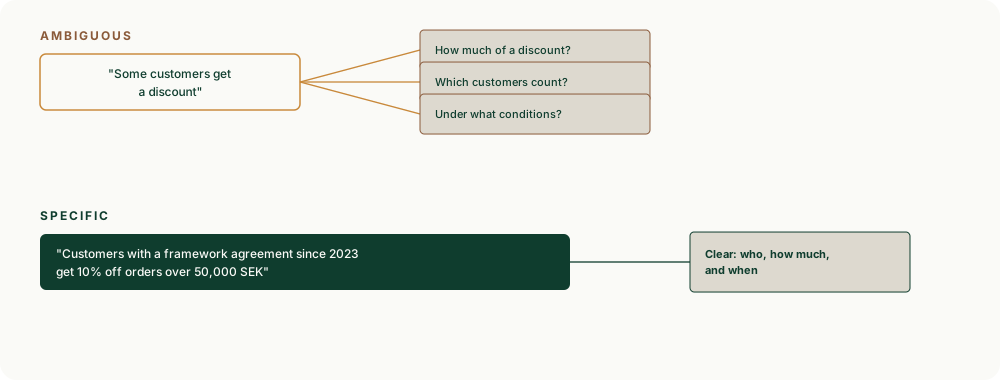
This isn't a tradeoff between writing for people and writing for machines. It's the same discipline. Ambiguity is always a problem, it's just invisible when a person is reading, because they can ask a colleague when something's unclear. An AI agent can't do that. It guesses, and delivers the guess as an answer with the same confidence as a correct one.
Three concrete techniques, all with real examples.
1. Make every paragraph self-contained
A person reading a full document carries context from earlier paragraphs. An AI agent retrieving information usually pulls a single excerpt, not the whole document. A paragraph that leans on "that process" or "in this case" without saying what it refers to becomes useless once it's pulled out of context.
Don't write "It's handled differently. It depends on the agreement signed in 2023." Write instead "Customers with a framework agreement from 2023 are handled under the terms that applied then, not the current standard process." The second version means the same thing whether it's read in context or alone.
2. State the conditions outright, don't write "it depends"
"It depends" is a valid conversational opener between people, it invites a follow-up question. In writing, with nobody around to answer that follow-up, it's a dead end.
Don't write "Pricing varies by customer." Write "Customers with annual revenue over 10 million SEK get 15 percent off. Everyone else pays list price."
If you find yourself writing "it depends," ask what it actually depends on, and write that instead.
3. Phrase headings as questions, not labels
A heading that just says "Pricing" works for a person browsing a table of contents. It rarely matches a real question an AI agent is trying to answer, or a search a person actually types.
A heading that just says "Exceptions" performs worse than one that asks "What do we do when a customer asks for a discount outside standard terms?"
The second heading is also more scannable for a person. That's not a compromise, it's just more clearly written.
Why it matters more now
When only people read documentation, ambiguity got resolved with a quick question to a colleague. The damage was small. When an AI agent answers on your behalf, there's no colleague to ask. The agent guesses from what's actually written, and a bad guess gets delivered with the same confidence as a correct answer. This is exactly the kind of source step four of the method points at: not just building a source, but writing it in a way that's actually trustworthy.
These three techniques cost nothing extra to apply. They take a little longer per paragraph, and save that time many times over every time someone, human or agent, actually needs the answer.
Want to see your documentation rewritten this way?
We'll walk through a real example from your company. Book a free call.
Book a demoJoin the newsletter.
A weekly summary of new insights, plus what's new at Opmore. No spam, just insights.