It's not AI taking your job, it's the person who decided that
By Mohammed Alsaadi
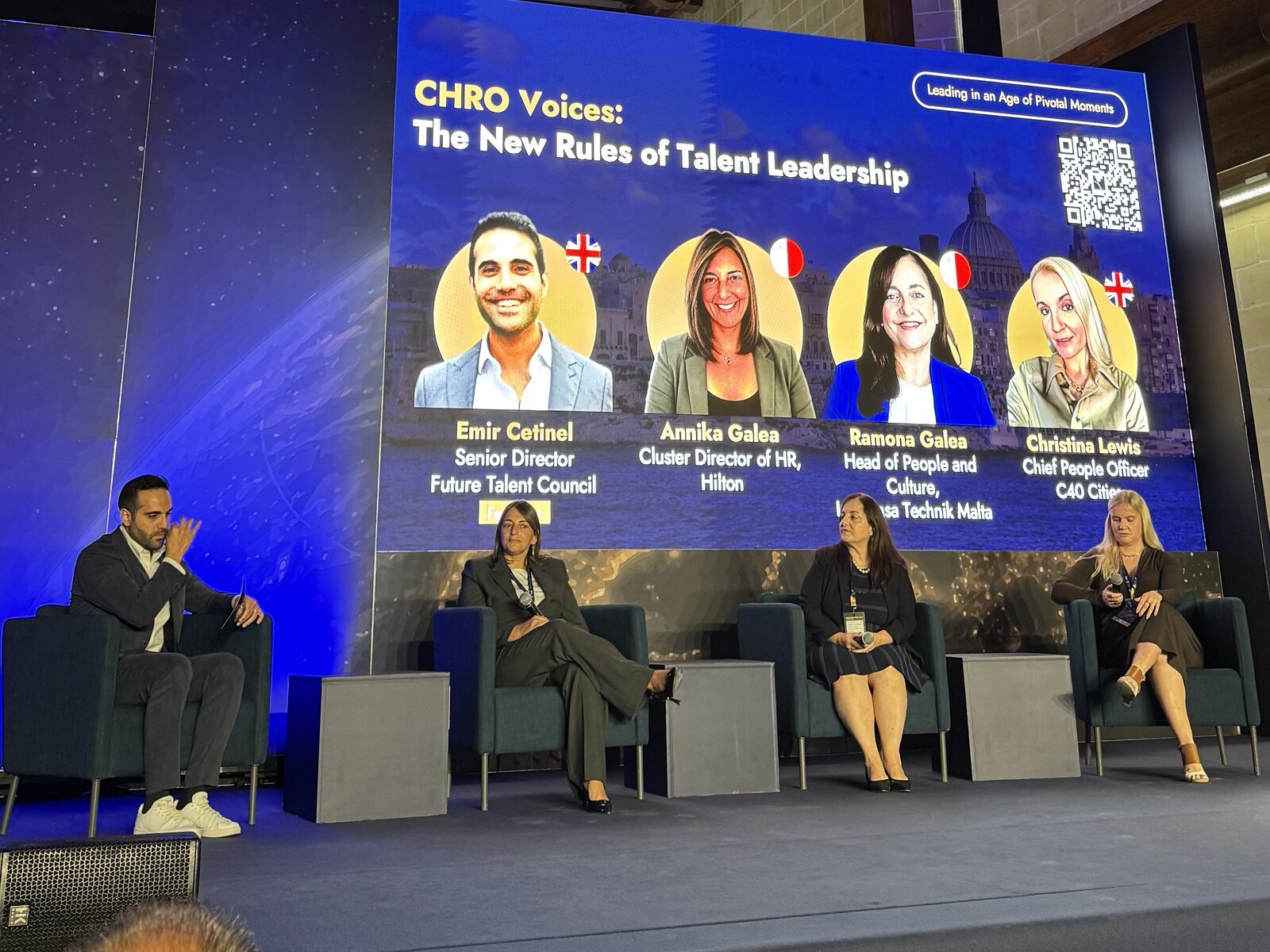
Day Two, mid-morning, and the panel was called "CHRO Voices: The New Rules of Talent Leadership." Three people who run the people function at very different organizations, facilitated by Emir Cetinel, Senior Director at the Future Talent Council. On stage: Annika Galea, Cluster Human Resources Director at Hilton. Ramona Galea, Head of People and Culture at an aviation maintenance organization with a 600-strong and growing workforce. Christina Lewis, Chief People Officer at C40 Cities, the network of around 100 mayors representing close to a billion people working on climate action.
A hotel group, an aircraft maintenance operation, and a global climate nonprofit. Different pressures, same questions: where does AI belong in the work, and what happens to the people whose jobs are built around being human.
In a human industry, being human is the hard part
Annika opened with the thing that should be obvious and turns out not to be. Hospitality is already a human industry. People come on holiday, for a wedding, for an event, to be looked after by a person. So the AI question there is not "should machines replace humans," it is "which parts of the human work were we doing on autopilot."
Her point was that critical thinking, judgment, empathy, reading someone's face to tell if they are happy or upset, none of that is automatic just because you were born human. "These are muscles that you need to develop," she said. Hilton is now being more deliberate about which processes need to feel more human than they used to, not less, even as more tools become available to automate around them.
No laptops in the interview
Ramona's organization sits at the other extreme: aviation maintenance, heavily regulated, where one mistake on an aircraft can be catastrophic. Her worry was not that people would refuse AI. It was junior mechanics getting instant access to information and tools that create a false sense of capability that has nothing to do with actual competence.
So she rebuilt how the organization hires and assesses. Less weight on the CV and the certification alone. More on adaptability, decision-making under pressure, and judgment, tested with case studies done on the spot, with no laptops or electronic equipment allowed. Not to catch anyone out, she said, but because the real question is what happens when you're faced with a situation and have to make a fast decision, in an industry where compliance and safety come first. The traditional path still exists too. It takes six to seven years of on-the-job training to become a certified aircraft engineer, and nothing about AI changes that timeline.
It's not AI taking your job
Christina brought the line of the session, and she was careful to credit it: someone else said it in a breakout the day before, and it stuck with her enough to repeat it on stage. It's not AI that's taking your job, it's the person who decided AI is going to take your job.
At C40, AI is mostly a tool for scaling impact. They built their own AI technology to measure emissions across member cities, and Christina's job internally is turning the fear in the room, the "is it going to take my job" conversation that comes up around AI the same way it comes up around flights in a climate organization, into something closer to "how do we take work off people's plates so they can focus on what they actually want to be doing."
She also talked about her own use of AI, and the analogy she reached for was skincare. AI contributes to the result the way a whole routine does: diet, exercise, skincare, not one product doing all the work. She uses it as a starting point for writing, then builds her own tone and structure from there. Her line for what does not work: if someone hands you a document and you can tell they don't understand the words in it, they typed a prompt and hit send, and that is not good enough. It comes straight back to their inbox.
Cleaning robots, not food robots
Asked where automation actually replaces people versus assists them, Annika drew a clear line by guest contact. Cleaning is close to fully automatable soon, since most rooms get cleaned when no one is in them. Check-in and checkout sit further along than people think. Some hotels already skip the front desk entirely.
Food is different. She could not picture a robot delivering her dinner and thinks people might genuinely prefer it stay that way, even if some hotels already run room service through robots. Her framing: this isn't really a technology decision. It's the guest deciding, at scale, whether they want efficiency and no mistakes, or connection and human interaction. Companies invest in whichever one the customer actually rewards.
Development needs to go wide, not high
The panel closed on a harder problem: entry-level roles thinning out in some industries and markets, and what that does to the pipeline of future leaders if fewer junior people get the years of experience the senior roles used to require.
Christina argued the traditional career ladder was already too narrow, with very few positions at the top, and AI will compress it further. Her answer is that development needs to be judged by width, not height. She pictured a future workforce that is not owned by one company or tied to one fixed role for a career, people applying a set of skills across different industries and formats as needed, more fluid and less built on bricks and mortar than the structure that has held for the last 150 years.
Annika made the same point from a different angle, using her own background. Her undergraduate degree was in dance, chosen because it was her way into university, not because it led anywhere obvious. What it taught her was resilience, persistence, and how to handle rejection, and those are exactly the skills she draws on now in front of her board. Her argument: those skills are not always built at work, and companies need to get better at recognizing and using the ones people bring in from everywhere else in their lives.
What I took from it
Three closing lines, three different answers to the same prompt about where the opportunity is. Ramona called it a privilege to be part of a shift this size, after a career where organizational change used to happen once a decade and now happens constantly, and said the job has moved from managing people to managing outcomes. Christina said the real opportunity is being more deliberate about what problem you're actually solving before reaching for AI, instead of dropping it into a workflow and hoping it helps. Annika took it past work entirely: her hope is that AI gives people back the freedom to have more of a life outside the office, after 250 years of a model built around most of your waking hours belonging to a job.
None of the three were describing a system that runs itself. Every version of "AI helps here" they gave came with a person who had rebuilt something first: the interview process, the internal conversation about fear, the routine for using the tool well. That is the part that matches what we see building role playbooks. The tool does not replace the judgment. Someone still has to work out how the role is actually done, write it down, and hand it to the next person so they are not starting from nothing on day one.
Talk to us about your project.
Book a callJoin the newsletter.
A weekly summary of new insights, plus what's new at Opmore. No spam, just insights.