El Iza Mohamedou: Skill systems that catch up, not predict
By Mohammed Alsaadi
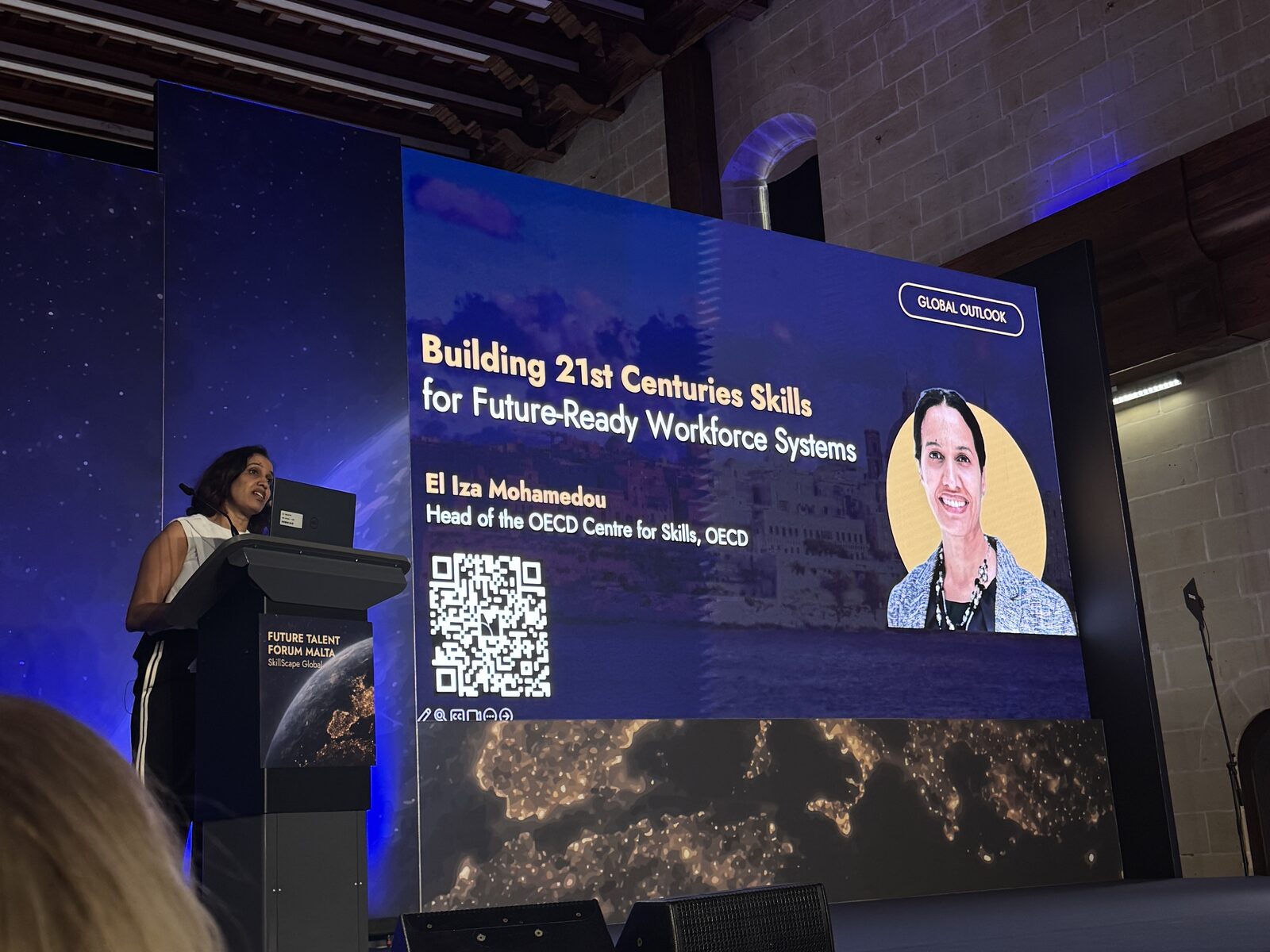
The second keynote of the morning followed straight on from the first. Mark Patterson had talked about national AI strategies and the "human stack." El Iza Mohamedou took the same question, systems, and went one level down: not what a country should aim for, but what makes a skills system actually able to respond when the ground shifts under it.
She heads the Centre for Skills at the OECD. The talk was built around a project her team ran with Malta's National Skills Council, and it used Malta's maritime sector as the worked example throughout.
Skill systems are getting hit from every direction at once
Her opening point was that there is no single force reshaping skill demand. There are several, landing together.
Investment in intangible assets, software, data, research, organizational knowledge, has grown more than three times faster than investment in physical assets since 2006. That changes both what companies spend on and what they need from the people who work for them.
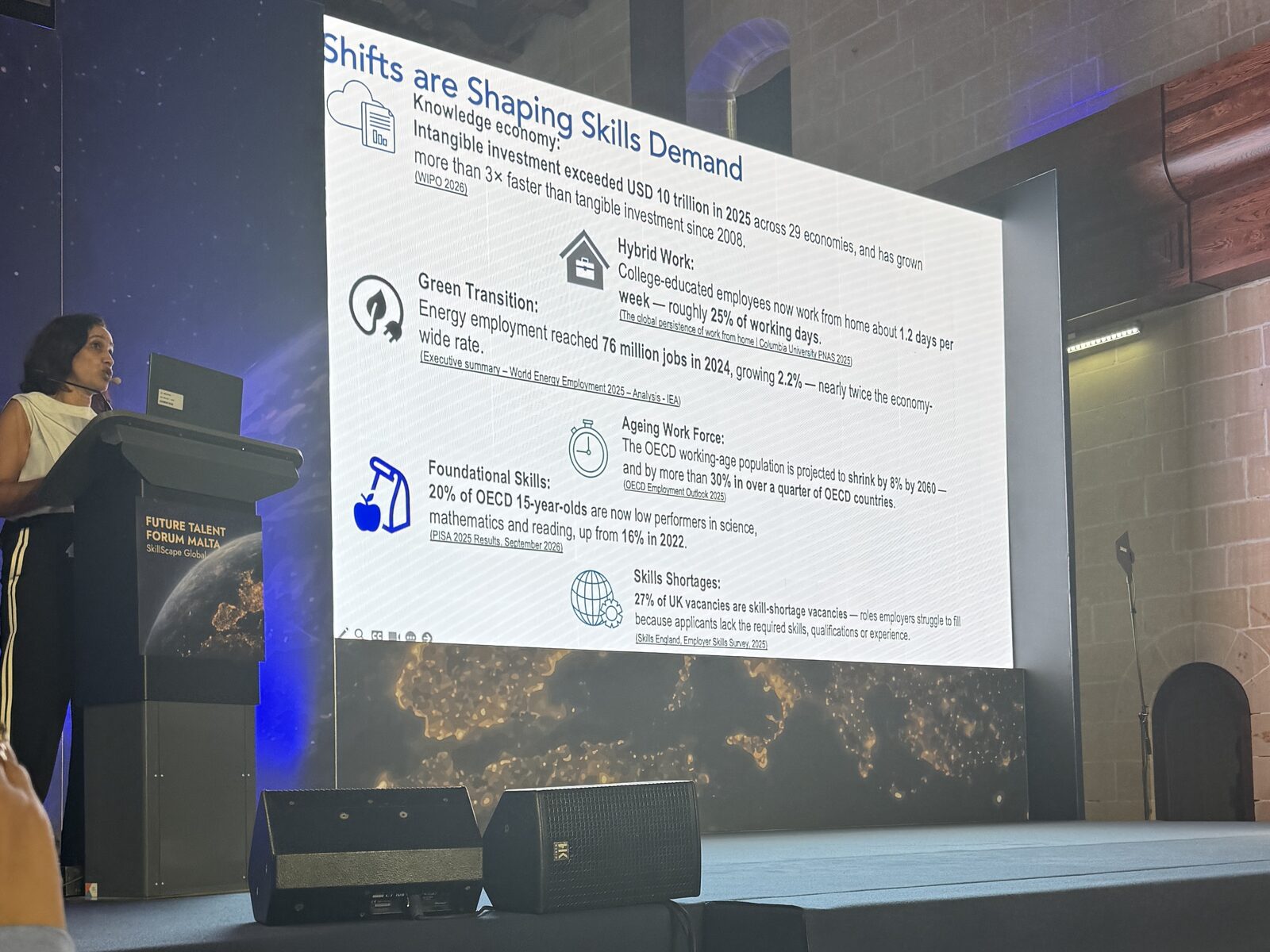
Hybrid work has stopped being a pandemic-era exception. Among college-educated workers, working from home has stabilized at around 1.2 days a week. Mohamedou pointed out this has real consequences for management, for collaboration, and for how people learn from the colleagues around them, since a chunk of that learning used to happen by osmosis in a room.
The energy transition is adding labor demand, growing at nearly twice the rate of employment overall, while the technical occupations needed to sustain that growth stay in short supply. And demographics are pulling the other way: the OECD working-age population is projected to shrink 8% by 2060, more than 30% in over a quarter of member countries.
Underneath all of it sits a skills gap that isn't closing. The OECD's PISA data, released the week of the talk, found that about 20% of 15-year-olds across the OECD are now low performers in science, math, and reading, a share that has been rising. In the UK Employer Skills Survey, almost 30% of vacancies go unfilled because applicants don't have the skills the job needs. As Mohamedou put it, they might have the degree, the credential, but not the skill the role actually requires.
More data is not the same as better policy
This was the sharpest point in the talk. Governments have more labor market information available to them than at any point before: employer surveys, online vacancy data, education records, regional labor market figures, career services, training providers. The OECD collects a lot of it.
The problem is that the information sits in pieces. Ministries, regions, and sectors each see part of the picture, without a shared view of the whole system. So the first job isn't collecting more data. It's building a shared diagnosis: where are shortages emerging, which occupations are actually changing in what they require day to day, and which groups face the biggest barriers to adapting.
The second job is coordinated action on top of that diagnosis, whether that means vocational education, adult learning, career guidance, or employer support. Her line on this was direct: more data does not automatically produce better policy. What matters is whether institutions translate the signal into a shared priority and then into action.
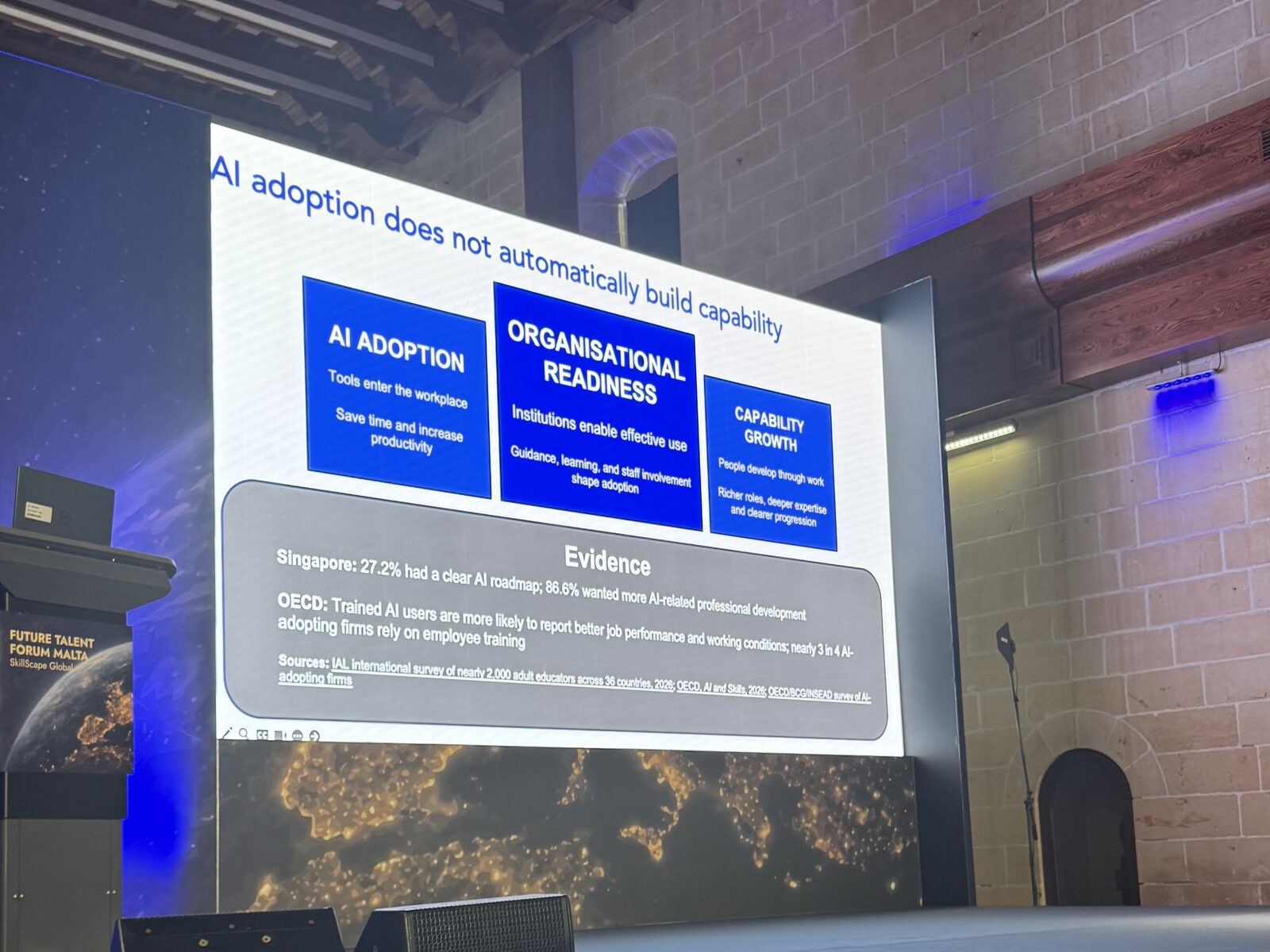
She used AI adoption as the clearest current example of that gap. Adoption is accelerating, but adoption by itself says very little about whether people and organizations are getting more capable. Research from the Singapore Institute for Adult Learning, which the OECD works with closely, found that fewer than 30% of adult educators surveyed said their organization had a clear AI roadmap, while more than 85% said they wanted more AI-related professional development. The signal is loud. The response hasn't caught up to it.
Malta's maritime sector, worked all the way through
The second half of the talk was the case study: a National Skills Strategy and Action Plan the OECD built with Malta's National Skills Council, Transport Malta, Jobs Plus and other partners, alongside a sector-specific Maritime Skills Action Plan.
The two documents work at different levels of the same system. The national strategy covers eight priority areas and around 30 recommendations, mostly about shared infrastructure: governance, a multi-skills observatory, funding, monitoring. The maritime plan goes deep on one sector, using a detailed skills gap analysis to define specific actions with named roles, timelines, and estimated costs. Mohamedou's framing: the national strategy sets the breadth, the sector work reveals what implementation actually requires, and evidence from the sector can feed back up into national policy.
The maritime numbers were the part that made the abstraction concrete. More than 70% of maritime employers report skills pressure. Nationally, 52% of employers name a lack of appropriate skills as a major barrier to hiring. Operations personnel are the most frequently cited hard-to-fill role, followed by maritime engineers, electricians, and technicians.
The pipeline data was the clearest single chart: online maritime job postings reached about 4,423 in a year, while enrollments in long- and short-term maritime training programs reached only around 2,100 in the same period. Demand has grown. Training participation has grown too, just not fast enough to close the gap, and Malta's small pool of unemployed adults and aging workforce make it harder to solve through recruitment alone.
Training existing isn't the problem either. 84% of maritime companies already provide some form of employee training. But 71% of employers still report skills gaps in their workforce, and almost half say current training doesn't meet their upskilling needs. Her point: participation in training doesn't automatically mean workers are developing the skills employers actually need, or that the training is targeted and flexible enough to keep up with how the work is changing.
The plan's recommendations followed from that diagnosis: raise awareness of maritime careers in schools, strengthen entry pathways with employer incentives and a national mentorship program, expand modular lifelong learning for the existing workforce, and support career transitions with flexible, stackable qualifications. A Maritime Skills Alliance ties it together with shared sectoral forecasting.
The detail she kept returning to was ownership. Every recommendation has a named policy owner and partner institution, phased delivery out to 2035, and an estimate of cost and administrative complexity. Her reasoning: shared responsibility, without a name attached, tends to become no one's responsibility. Everyone sits at the table, and at the end of the day nobody owns what happens if it goes wrong.
What she picked when asked
In the short Q&A after, asked for one thing that worries her and one that gives her some optimism, she went back to the PISA decline as the worrying one, a sign that how skills are taught needs to change. For the optimistic one, she pointed at young people themselves: they're already using AI. The job for institutions isn't to wait for them to catch up, or to try to pull them back. It's for the system to catch up to how they're already using it.
What this means if you're the one building the system
Most of this talk was aimed at national policy, not at a single company. But the mechanism underneath it applies at any size. A skills gap doesn't get fixed by collecting more information about it. It gets fixed when someone owns turning that information into a specific, timed action, and someone else can point to who is responsible when it doesn't happen.
That's the same problem a company faces on a smaller scale in someone's first week. The knowledge of how a role actually works exists somewhere, usually in the head of whoever has been doing it. The gap isn't information. It's whether that knowledge gets extracted into something a new person can use before they're expected to already know it. Mohamedou's maritime plan works because every recommendation has a name attached. A role playbook works on the same principle: what good looks like in this job, written down, owned, and ready before day one instead of learned by accident over six months.
Talk to us about your project.
Book a callJoin the newsletter.
A weekly summary of new insights, plus what's new at Opmore. No spam, just insights.