Elena Magrini: You don't need a crystal ball, you need data
By Mohammed Alsaadi
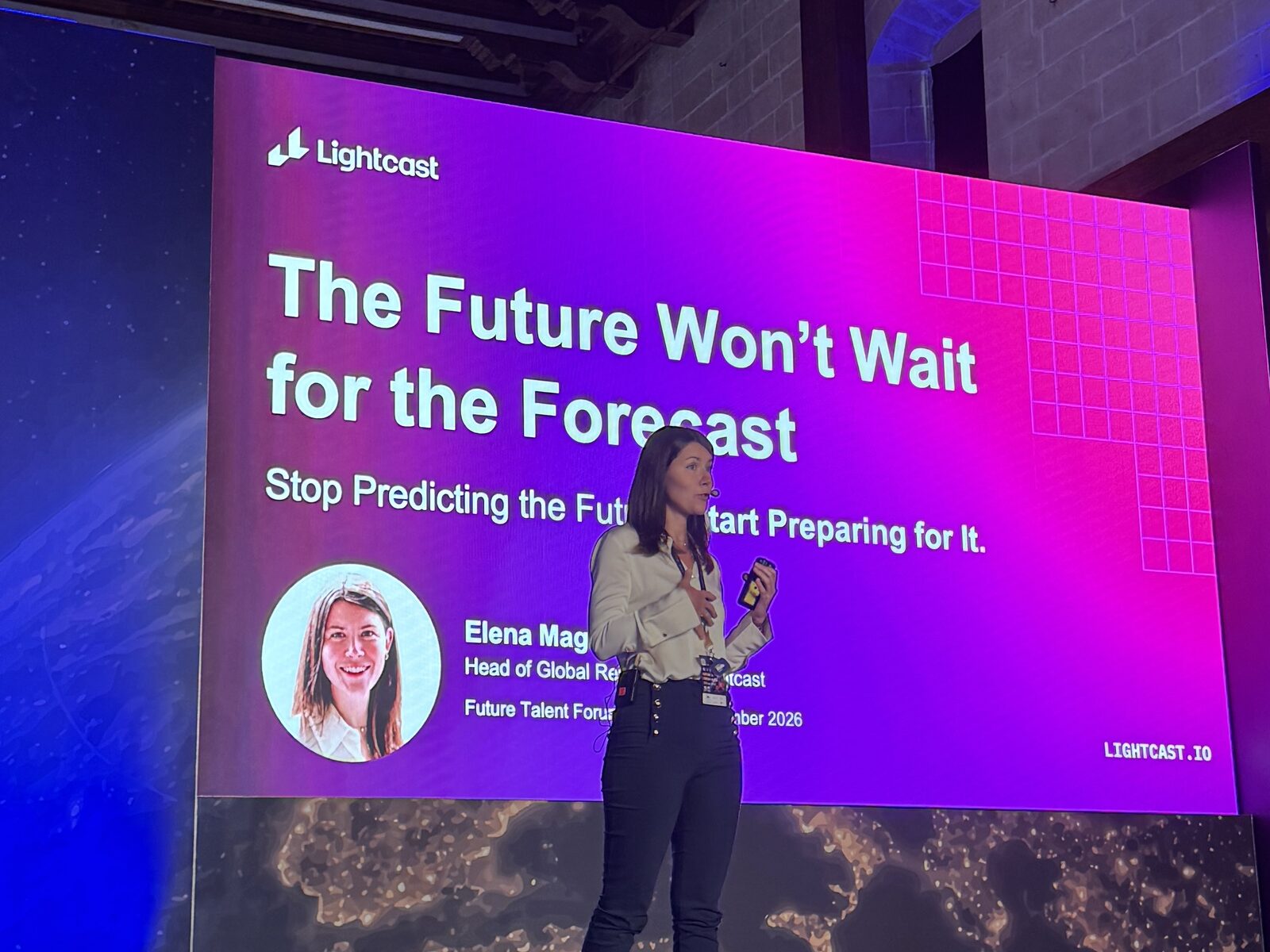
The last session of two days in Valletta was the closing keynote, Stop Predicting the Future, Start Preparing for It, and Elena Magrini opened by asking the room how many people had checked the weather forecast before flying in. Most hands went up. The forecast said rain both days. It didn't rain. That was her whole argument in one joke: forecasts are fine for cheap, reversible decisions like packing an umbrella. They are the wrong tool for the decisions this room actually makes.
Magrini is Head of Global Research at Lightcast, and she had the hardest slot of the conference, right after lunch on day two, standing between four hundred people and the exit. Her fix for that was to ask for brains instead of hearts. Take everything the last two days built up, she said, and turn it into one thing you can actually do when you get home.
Why forecasts fail on the questions that matter
Her point wasn't that forecasting is worthless. It's that forecasting only works when a decision is cheap and reversible: take the umbrella or don't, change your outfit for the weather. Most of what the conference had spent two days on isn't that kind of decision. A new education program takes years to design and years more before you see whether it worked. A company's workforce planning decision shows its return years out. Policy decisions are the same. If you're only looking at a forecast to make a call like that, she said, you fall into one of two traps.
The first trap is waiting for certainty. Organizations keep checking the forecast, hoping it will eventually resolve into something solid enough to act on. It won't. Change is constant, and nobody in the room raised a hand when she asked if anyone expected certainty about the future any time soon.
The second trap is treating one forecast, at one point in time, as the truth. You find the most credible-looking number, put all your weight on it, and prepare for that one future. There is no one single future, and nobody knows where the next disruption comes from.
Her alternative wasn't to throw out forecasts. It was to stop looking for more of them and start using data differently: not to predict what happens, but to prepare for it.
Three things we can say with confidence
Magrini said there are three things about the future she'd put at roughly 90 percent confidence, even without knowing what specifically happens next. More changes are happening at the same time, not one black swan at a time but several at once. The pace of that change is accelerating. And the systems most organizations run on today, some further behind than others, were not built for this rate of change.
Her answer to all three was a word that had already come up in that morning's roundtable: fluid. Organizations need to be more agile, more flexible, and that means building a new kind of strategy around three things: asking better questions, building the intelligence to answer them, and pulling in the right coalition of people, one that can change depending on the problem.
Reframe the question before you reach for data
She ran through the three questions she hears most often from the people she works with, and showed how each one, asked the wrong way, leads nowhere.
From companies: is AI going to take jobs? A binary question with a binary answer, and neither answer helps you plan. The better version: how is work changing, and how do we want it to change?
From universities: is the career ladder breaking for young people? Also unconstructive as a question. Reframed: how do we want to design the pathway from education to work, and what can we change right now?
From policymakers: what's going to happen in a specific region? Reframed: how do we prepare for change in a way that's relevant to our own local economy?
Redefining work: a 2x2, not a binary
Most conversations about jobs treat them as going up or down in demand, one column, binary. Magrini's team builds a second axis: whether the content of a role is also changing, whether people are taking on more responsibility as parts of their job get automated, or narrowing into the parts a machine can't do and getting more value for that specialization.
Cross those two dimensions and you get four categories instead of two, and a much less binary picture of the labor market. The number she gave from Lightcast's research: seven in ten jobs fall into what her team calls the enrichment category, roles where you need fewer people but each person is doing more. She asked the room how many people were doing more tasks in their day job than they were a few years ago. A lot of hands went up.
Only three in ten graduates land an exact match, and that's the wrong number to chase
On the education side, she picked apart the standard way universities measure their own value: whether a graduate's job matches their degree exactly. An accounting student who becomes an accountant. By that measure, only three in ten students end up in a field that matches what they studied, and that share has fallen five percentage points over the past decade.
Her point wasn't that three in ten is a bad number. Education was never meant to hit ten out of ten on that measure, and someone discovering at eighteen that their chosen field isn't for them and moving on isn't a failure. But if you measure value differently, by whether students go on to work in a field related to the skills they built rather than the exact title on their certificate, the number jumps to five in ten, twenty percentage points higher. That broadening shows up across the whole curriculum, not in one corner of it.
One more finding she pulled from the same research: among technical skills, the ones that travel furthest and open the most career doors, regardless of field of study, are management and business skills.
Five rules for turning data into a decision
She closed the main part of the talk with five things to check before you trust a number, useful well outside the labor market:
Triangulate. A single data point, on its own, isn't worth much. Combine data sets and question each number before you build a decision on it.
Benchmark it. A number without a comparison point tells you nothing. Compare against a national average, a sector average, or yourself a year ago.
Pick the right unit of analysis. If you only look at jobs labeled "AI jobs," you're missing most of what's happening. Less than 10 percent of AI's impact on the labor market shows up as a distinct AI job title. The rest shows up inside existing jobs, in the tasks and skills that make them up.
Be transparent about assumptions. There's no perfectly clean number. Say what you're measuring, and what the tradeoffs of that choice are.
Keep monitoring. A report is a snapshot. At the pace things are moving, she said research can go stale within months, not years.
Her final point was about people, not data. No single organization has the full picture of the labor market. Everyone sees it from their own angle, and building a shared, accurate picture takes a coalition, both at the national level and down at the regional and sector level where the real detail lives. She closed by asking the room for thirty seconds of silence to think of one action to take home. You don't need a crystal ball. You need better questions, real data, and the right people at the table.
What came up in the Q&A
Asked what other data sets Lightcast combines to triangulate its own numbers, Magrini said job postings and worker profile data are never enough alone. She pairs them with official statistics: completion data from education systems, vacancy data broader than online postings, migration data, and productivity data.
Asked about a recent Lightcast report on AI's reach, she confirmed the finding directly: AI is no longer an IT-only story. That was true two or three years ago and isn't anymore. Employers now pay a premium for workers with AI skills in roles well outside tech, and the mistake is treating "AI skills" as one thing instead of understanding what it means role by role.
Why this one stuck with me
The line that mattered most to me wasn't about labor markets in general. It was the reframe from job titles to tasks and skills. Two people can hold the same job title and be doing almost nothing alike, and a resume or a certificate tells you neither. What actually predicts whether someone can do a role well is the specific set of tasks it involves and the judgment calls that come with them, which is exactly what gets lost between the person who's done a job for years and the person about to start it. That's the gap we built Opmore to close: not by predicting who'll be good at a role, but by capturing how the role is actually done, so the next person doing it doesn't have to guess their way through the first few months.
Talk to us about your project.
Book a callJoin the newsletter.
A weekly summary of new insights, plus what's new at Opmore. No spam, just insights.